Nasdaq Forecast 2027: Could the Next Great Tech Bull Market Be Coming?
Why the Nasdaq still matters, where it can mislead investors, and the best technology stock opportunities for 2027–2031.
Some investors made fortunes during the recent great technology bull market. Could a repeat bull tech stock rally be just ahead, perhaps the face ripping rally that Tom Lee has forecasted?
The NASDAQ, Mag 7 and AI stocks are taking quite a beating in price right now. A perfect storm wave is hitting the markets, currently weighed down by the Mid-term election worries, AI stock bubble, and high, rising oil prices and the plague of inflation.
Whether this is market bottoming is part of the complex view of technology stocks listed on the NASDAQ. The NASDAQ is an important part of the stock market forecast picture, especially given the role of AI in the coming 4th industrial revolution led by the United States. In this post we take a closer look at the NASDAQ and perhaps question whether it’s causing investors to misunderstand investing opportunities, causing them to miss out on artificial intelligence, semiconductors, cloud computing and other high-growth businesses.
NASDAQ’s Long Bull Run
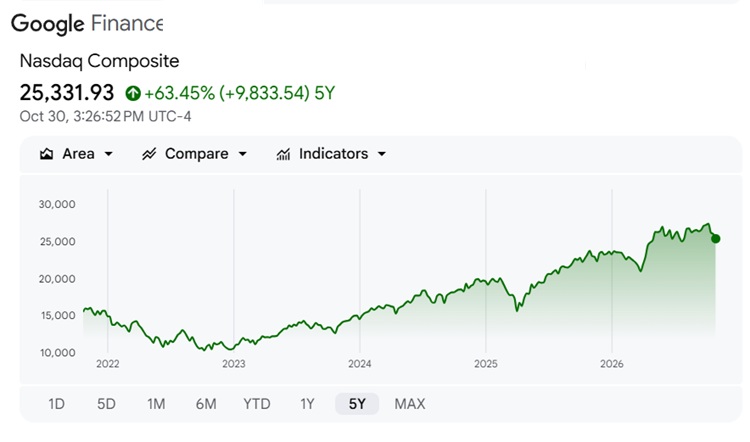
The NASDAQ has gained impressively for more than 4 years, and we might wonder if this is the end of the party. Yet AI is something special, geared to rebuild the entire US economy and power up a good portion of publicly listed companies. The stock market experts seem to be of the view, with their postive forecasts, that we’re on the cusp of another big upward run.
During earlier bull markets, investors who recognized the earnings potential of companies such as Microsoft, Apple, Amazon, Nvidia and Alphabet—and held their shares through the inevitable market corrections—sometimes accumulated extraordinary wealth. The performance and spending of these companies too, as part of the hyperscaler group, determines which AI stocks are best to buy.
Yet those successful investors endured major selloffs, negative forecasts, recessions, expensive valuations and periods when enthusiasm for technology virtually disappeared.
The Nasdaq’s recent decline is reviving those familiar doubts. Investors who enjoyed the previous rally are protecting profits. Others are wondering whether prices have fallen far enough to justify buying. And those who missed much of the last bull market don’t want to miss the next one (FOMO investors).
4 NASDAQ Forecasts for 2027
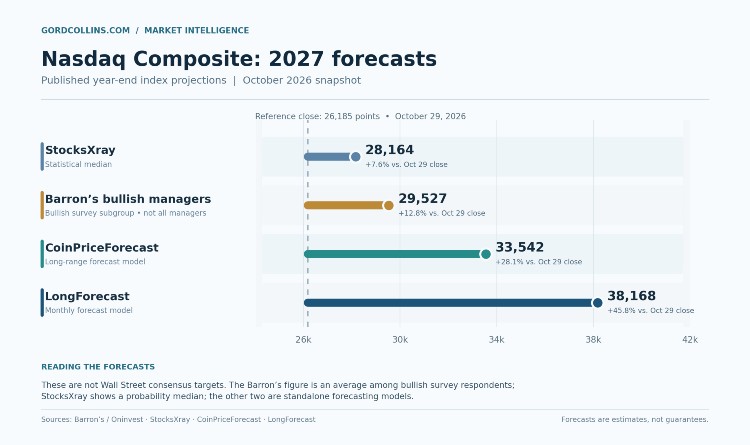
But there’s an important distinction between forecasting the Nasdaq and identifying the technology stocks that could create the most wealth over the next five years.
The Nasdaq is a useful indicator of market sentiment and investor confidence. It is not a comprehensive measure of technology investment value.
The next generation of big winners might include familiar Nasdaq giants. But it could also include semiconductor manufacturers, electrical equipment providers, cybersecurity companies, industrial automation businesses and smaller software companies that barely influence the index today.
Let’s examine what the Nasdaq is telling us—and what investors need to look beyond it to discover.
Nasdaq Selloff: What Is Worrying Investors Right Now?
The Nasdaq Composite closed October 29, 2026, at 26,184.72, down 1.38% on the day. Selling intensified on October 30, with the index dropping more than 3.5% additionally during today’s trading. Fundstrat’s Tom Lee called it a “liquidation event.” I think equities have retreated much further than Tom predicted or envisioned. All of the fear mongering media talk about overvalued AI stocks seems to created an effect. But analysts see Nov 4th being a turnaround day.
The problem right now less about technology’s relevance to economies, but may be more about questions on the enormous amounts of money being spent on artificial intelligence. Of course those questions were always there. It is the decreasing returns, economic outlook, and fears about what AI will do to the work force and tax base that has some concerned about this dominant AI investment theme.
Amazon, Alphabet, Meta, Microsoft and other technology leaders are investing heavily in AI infrastructure. These companies expect rising demand for computing, cloud services, automation and intelligent software to generate profitable growth. Yet the spending taking place now, won’t return revenue and profits for many years. Patience may be running thin, and it’s at a bad time for the overextended AI infrastructure companies. And the bottlenecks that were anticipated might not happen. Thus everyone’s picks of the best of them might completely wrong. For those who want to gamble, AI stocks are at bargain basement prices.
Recent earnings announcements have highlighted several concerns:
- AI infrastructure costs are rising faster than expected in some businesses.
- Free cash flow is under pressure as companies build data centres and purchase expensive equipment.
- Traditional revenue sources, including digital advertising, face disruption from new AI-powered services.
- Interest rates and financing costs remain elevated.
- Investors are reconsidering how much they should pay today for earnings expected in 2027, 2028 and beyond.
This changes how Wall Street analysts evaluate the technology sector.
Previously, announcing a major investment in AI could send a company’s stock soaring. Now, investors increasingly want evidence of how that spending will produce revenues, operating profits and returns on capital. It’s not such a bad thing to give the capital-stuffed AI companies a wake up call and start making AI profitable. Of course, if small to mid sized businesses are struggling, it stands to reason that the full demand for AI is latent. The US economy needs to get rolling, and lower energy prices and lower interest rates will ignite that fire.
A technology market that rewards profitable innovation rather than spending announcements could eventually produce healthier, more sustainable investment opportunities.
The important question then is whether companies are suffering temporary financial pressure while building valuable businesses—or spending heavily on projects that will never earn an adequate return. Those two situations can look surprisingly similar during a market selloff.
Why the Nasdaq Is Still Relevant
The Nasdaq remains one of the world’s most useful indicators of technology-oriented investment sentiment. The index reflects the market’s expectations for businesses involved in artificial intelligence, software, digital platforms, semiconductors, communications, biotechnology and other innovation-driven industries.
Many of these companies can expand internationally without the same physical distribution costs that traditional businesses face. Successful software and digital services businesses may also generate exceptionally high margins and recurring revenue. That combination helps explain why technology has attracted that massive investment capital over the past several decades.
The Nasdaq is particularly useful for evaluating three things.
First, investors’ willingness to pay for future growth. When optimism rises, investors often pay higher valuations for expected future earnings. When uncertainty increases, those valuation multiples can contract sharply.
Second, confidence in large technology companies. Strong Nasdaq performance often accompanies optimism about corporate technology spending, digital consumption and profit growth.
Third, changing expectations about interest rates and economic growth. Technology valuations can be unusually sensitive to changes in expected earnings, bond yields and the cost of capital.
However, the index itself has significant limitations. A rising Nasdaq doesn’t necessarily mean most technology stocks are performing well. A relatively small number of enormous companies can account for much of the index’s gains. Equally, a falling Nasdaq doesn’t prove that every technology company’s business prospects are deteriorating.
Companies and sectors have their own unique supply, demand and business opportunities given technology is used across all industries now.
What Is the Nasdaq? Understanding the Important Indexes
The Nasdaq is a major U.S. electronic stock exchange where thousands of domestic and international companies trade their shares.
The Nasdaq exchange is where stocks are listed and traded and the Nasdaq indexes is a weighted average of the listed stocks.
Several indexes are particularly useful for technology investors.
| Index | What it measures | Why investors should follow it |
|---|---|---|
| Nasdaq Composite (COMP) | Thousands of Nasdaq-listed securities, weighted largely by market capitalization | Broad view of Nasdaq market performance and investor sentiment |
| Nasdaq-100 (NDX) | 100 of the largest eligible non-financial Nasdaq-listed companies | Major benchmark for large-cap growth and technology-oriented investment |
| Nasdaq-100 Equal Weighted (NDXE) | The Nasdaq-100 constituents, initially assigned equal weights at rebalancing | Helps show whether performance extends beyond the largest companies |
| Nasdaq Next Generation 100 (NGX) | The largest eligible Nasdaq-listed non-financial companies outside the Nasdaq-100 | Useful for monitoring companies below the mega-cap tier |
| PHLX Semiconductor Index (SOX) | 30 companies focused on semiconductor-related businesses | Measures an industry central to AI infrastructure and computing |
| S&P 500 Information Technology Index | S&P 500 companies classified in the information technology sector | Offers a technology-sector benchmark not restricted to Nasdaq listings |
The Nasdaq-100 is particularly important because it underlies widely followed exchange-traded funds such as Invesco QQQ and QQQM.
Investors sometimes confuse the Nasdaq-100 with the entire Nasdaq stock market. But the Nasdaq-100 concentrates on large non-financial companies and is not restricted exclusively to technology businesses.
Similarly, the Nasdaq Composite is not a pure technology index. It also contains companies from other sectors.
What About the Nasdaq-30?
There isn’t a major standard broad-market Nasdaq-30 index comparable to the Nasdaq-100. Investors may be thinking of the Dow Jones Industrial Average, which tracks 30 prominent U.S. companies, or the PHLX Semiconductor Index, which currently tracks 30 semiconductor-related companies.
For technology investors, the semiconductor index is particularly relevant because the fortunes of chip designers, manufacturers and suppliers can provide an earlier indication of changing demand for advanced computing.
The Dow Jones meanwhile, offers an additional perspective on large established American corporations, including companies outside the technology industry.
For an investor trying to identify the next technology bull market, retail investors should pay particular attention to the Nasdaq-100, its equal-weighted counterpart, the Next Generation 100 and the semiconductor index. Together, they tell us considerably more than the headline Nasdaq Composite alone.
Is the Nasdaq Distracting Investors from Better Opportunities?
It can, just like watching the US housing market price indexes, may have little relevance to a home buyer in Malibu, Los Angeles. The Nasdaq can create the impression that technology investing revolves around a handful of familiar mega-cap stocks. It might encourage over-investing in those MAG7 type stocks thus inflating their true value. Investors become overly involved in those megacaps. Still, many investors do like the lower risk profile of the NASDAQ 100.
Investors follow Nvidia, Microsoft, Apple, Amazon, Alphabet and Tesla because these companies generate enormous headlines and heavily influence major benchmarks. Yet as I mentioned, technological expansion creates opportunities throughout entire industries.
An investor following only the biggest Nasdaq companies might concentrate on AI stocks that include AI chip designers and neo cloud providers. But someone examining the wider AI infrastructure market might identify demand for advanced manufacturing equipment, memory chips, networking, cooling, electrical distribution, power generation and grid construction.
Companies serving those markets may be listed on the New York Stock Exchange, overseas exchanges or other markets.
Non, NASDAQ-100 stocks such as Eaton, Vertiv, Iren, GE Vernova and Quanta Services are publicly traded businesses worth evaluating for their exposure to electrical infrastructure and rising computing-related power demand.
The market for technology investment opportunities is considerably larger than the Nasdaq itself.
This is why investors should follow the money being spent throughout an industry rather than simply following the most popular technology stocks. The companies that capture the most sustainable profits aren’t always the businesses attracting the most publicity.
Is There a Better Way to Measure Technology Stock Valuations?
Absolutely. The Nasdaq measures changes in stock prices. It doesn’t tell investors whether those prices represent good value. An index can fall 20% and still contain expensive stocks. Likewise, an index near an all-time high can include individual companies trading at attractive valuations.
Six measures can help you evaluate technology companies against their expected profits, cash generation, financial strength and growth opportunities:
- Forward price-to-earnings ratio. How much is an investor paying for each dollar of expected 2027 or 2028 earnings? A company trading at 30 times projected earnings needs a convincing growth outlook.
- Expected earnings growth. Can the company increase earnings per share faster than its valuation is likely to decline? Earnings growth can sometimes overcome valuation compression, but not always.
- Free cash flow. How much cash remains after operating expenses and capital investments? This is becoming especially important for AI infrastructure companies.
- Return on invested capital. Is management generating an attractive return from the money being invested in new facilities, products and acquisitions?
- Competitive strength. Does the company control proprietary technology, valuable customer relationships, scarce manufacturing capacity or another advantage competitors cannot easily reproduce?
- Financial resilience. Can the business endure falling demand, rising interest rates or another market correction without excessive borrowing or shareholder dilution?
Consider a hypothetical technology stock trading at $300 with annual earnings of $10 per share which is a price-to-earnings ratio of 30. Then if earnings climb to $18 per share over the next several years that’s a remarkable 80% increase. If investors are then willing to pay only 20 times earnings, the stock would trade at $360.
Earnings rose 80%, but the stock gained only 20%.
That illustrates why an excellent company is not automatically an excellent investment at every price. Investors need to distinguish between the quality of the business, the strength of its growth prospects and the valuation already reflected in the stock.
For technology sectors, I would combine fundamental valuation analysis with Nasdaq market trends, industry-specific indexes and equal-weighted performance measures.
This gives you a more reliable and confident view of technology investment opportunities than just the Nasdaq Composite alone.
Could Another Great Technology Bull Market Be Developing?
There are credible reasons to believe a new sustained bull market could emerge between 2027 and 2031.
The technology expansions that created enormous investment wealth during previous decades were driven by powerful changes in how consumers and businesses operated.
Personal computers, the internet, e-commerce, smartphones, cloud computing and digital advertising transformed entire industries. Artificial intelligence, advanced robotics and autonomous systems have the potential to produce another major transformation.
What makes the current opportunity particularly interesting is that AI is not simply another consumer application.
It can potentially improve manufacturing, scientific research, logistics, healthcare administration, software development, engineering, financial services and countless business processes. And expanding AI use requires physical infrastructure—chips, memory, networks, electricity, cooling and manufacturing equipment.
Not often mentioned by the media is the the belief by some economists that we are on the brink of the 4th industrial revolution — a 21st-century shift that merges physical, digital, and biological systems, popularized ten years ago by Klaus Schwab, founder of the World Economic Forum.
And let’s look at two related industry forecasts.
- The World Semiconductor Trade Statistics organization projects worldwide semiconductor sales of approximately $1.9 trillion in 2027, representing 27% growth from its projected 2026 level.
- The International Energy Agency projects global data-centre electricity consumption will increase from approximately 485 terawatt-hours in 2025 to 950 terawatt-hours in 2030.
Those projections point to major demand for computing hardware and the infrastructure required to support it. However, strong industry demand doesn’t guarantee high investor returns. Competition, overbuilding, technological obsolescence and excessive valuations can still destroy shareholder wealth.
Therefore, the companies most likely to reward patient investors are those that can turn rising demand into durable earnings and free cash flow.
Remember What Happened in Previous Technology Bull Markets
The wealth created during the great technology rallies wasn’t distributed equally. Some investors bought leading companies early, held them through difficult periods and benefited as their profits and market values expanded. Others bought at inflated prices, concentrated too heavily in speculative businesses or sold during major corrections. And then other investors simply remained on the sidelines because the economic outlook seemed too uncertain.
And there’s no guarantee that a rosy five year stock market forecast includes a repeat. There are plenty of economic doonsayers online. However, it’s worth for you to keep in mind that major investment opportunities often develop while investors are still preoccupied with the problems of the previous market cycle. Their doubt and lacks of confidence is presenting you with a unique buy the dip opportunity.
The next technology bull market may already be taking shape beneath today’s volatility. The challenge is identifying which companies will earn the profits that justify higher stock prices.
Best Technology Stock Opportunities for 2027–2031
Your quest however, is to by the best tech stocks. I’m working on a stock selection system you can use right now. I’ll let you know when you can download the spreadsheet. You might not want to buy stocks simply because they’re listed on the Nasdaq-100. Why not evaluate the industries where spending, technological adoption and profit opportunities are likely to expand?
Here are six areas you might wight to watch closely:
| Investment opportunity | Companies worth researching | Why it matters—and the risk |
|---|---|---|
| AI processors and custom chips | Nvidia (NVDA), Broadcom (AVGO), AMD (AMD), TSMC (TSM) | Accelerated computing remains central to AI expansion. Risks include competition, export restrictions and high valuations |
| Advanced memory and chip manufacturing | Micron (MU), ASML (ASML), Applied Materials (AMAT), Lam Research (LRCX) | Demand for advanced chips and memory creates opportunities throughout manufacturing. Risks include cyclicality, bottlenecks and excess capacity |
| AI networking and data-centre infrastructure | Arista Networks (ANET), Vertiv (VRT), Eaton (ETN) | Growing computing requirements increase demand for networking, cooling and power equipment. Risks include project delays, pricing pressure and expensive stock multiples |
| Cybersecurity | Palo Alto Networks (PANW), CrowdStrike (CRWD), Fortinet (FTNT) | More digital systems and AI adoption expand the need for security. Risks include competition, spending constraints and high valuations |
| Enterprise software and AI productivity | Microsoft (MSFT), ServiceNow (NOW), Salesforce (CRM) | Businesses will increasingly want measurable productivity improvements from AI. Risks include AI disruption, uncertain monetization and customer spending restraint |
| Electrical grids and industrial infrastructure | GE Vernova (GEV), Quanta Services (PWR), Eaton (ETN) | Data centres and electrification create demand beyond traditional technology companies. Risks include project execution, financing and the pace of power infrastructure investment |
These are research candidates, not a ranked list of undervalued stocks or verified buy recommendations. Their attractiveness depends on the share price, forecasts and balance sheet at the time of purchase.
1. Semiconductors: Essential, but More Selective
Semiconductors are fundamental to the continuing expansion of artificial intelligence.
Advanced processors, memory and networking chips are needed to run ever more sophisticated computing workloads.
Nvidia remains an important company to monitor. However, its future stock returns depend on more than revenue growth. Investors also need to consider the sustainability of AI infrastructure spending, competition from custom processors and the valuation attached to expected earnings.
Broadcom, TSMC, Micron and semiconductor manufacturing equipment companies offer other ways to participate.
The key question is whether each business can grow profits through the next industry cycle rather than merely benefit from today’s exceptionally strong demand.
2. Electricity and Infrastructure: An Opportunity Outside the Nasdaq
One of the most interesting consequences of AI growth is its demand for physical infrastructure.
Technology companies cannot keep expanding data-centre capacity without access to electricity, cooling systems, transmission equipment and reliable power supplies.
That creates potential investment opportunities for industrial manufacturers and infrastructure providers.
Eaton, Vertiv, GE Vernova and Quanta Services deserve attention because parts of their businesses can benefit from increasing electricity and infrastructure requirements.
Some of these businesses may capture demand regardless of which AI software platform ultimately dominates.
But their share prices can also become expensive when investors anticipate years of strong growth. Order backlogs, project margins and cash flow deserve careful scrutiny.
3. Cybersecurity: Growth with Potentially Recurring Revenue
As businesses introduce more AI-enabled systems, digital infrastructure becomes more complicated.
That increases the potential need for cybersecurity, identity protection, cloud security and automated threat detection. Cybersecurity companies with strong customer retention and recurring subscription revenue could benefit.
Palo Alto Networks, CrowdStrike and Fortinet are worth researching, although investors should evaluate customer spending, operating margins, product competition and valuation rather than assuming that every cybersecurity company will prosper.
4. Business Software: Where AI Must Prove Its Value
The first phase of the AI investment boom has been dominated by infrastructure spending.
The next phase needs to deliver measurable business results.
Companies using AI want to reduce administrative work, accelerate software development, improve customer service, support better decisions and increase employee productivity.
Enterprise software businesses such as Microsoft, ServiceNow and Salesforce are positioned to compete in this market.
However, AI can also threaten established software pricing models. New entrants may offer similar capabilities at lower costs. Investors should look for evidence of paid AI adoption, higher revenue per customer, customer retention and sustainable margins.
5. The Next Generation of Technology Leaders
Perhaps the most intriguing opportunities are companies that don’t yet dominate major technology indexes.
The Nasdaq Next Generation 100 provides one place to begin researching larger emerging businesses outside the Nasdaq-100.
Investors can also examine promising companies listed on other exchanges or operating internationally. The aim is to find businesses with accelerating revenues, improving profitability, strong competitive advantages and room to expand into much larger markets.
Some may become tomorrow’s Nasdaq-100 constituents. Others may never join the index and could still become great tech stocks to buy, powering a better 401k or other portfolio.
The danger is that many smaller growth companies won’t be able to satisfy investors and analysts performance expectations. For this reason, balance-sheet strength, dilution, cash flow and business quality matter more than an exciting industry narrative.
Nasdaq Forecast for 2027: Three Possible Outcomes
Feeding the Prediction: The Nasdaq’s direction in 2027 will depend heavily on inflation, interest rates, corporate profitability and the financial returns generated from AI investments. Rather than placing excessive confidence in a single index target, investors should consider three scenarios.
| Scenario | What would drive it? | Implication for technology investors |
|---|---|---|
| Bullish: New tech bull market | Stronger earnings, improving AI monetization, easing inflation, declining bond yields and broader participation | Quality growth companies could resume strong gains, with opportunities extending beyond mega-cap technology |
| Base case: Selective recovery | AI demand remains healthy but valuations normalize, borrowing costs stay elevated and earnings outcomes diverge | Stock selection and reasonable entry prices become more important than owning the Nasdaq as a whole |
| Bearish: Extended correction | Persistent inflation, higher interest rates, weak returns on AI spending, geopolitical disruption or economic recession | Highly valued and debt-dependent companies remain vulnerable; stronger businesses may offer better opportunities after further declines |
My working outlook for 2027 is a selective technology recovery with the potential to develop into a broader bull market if earnings growth and cash generation improve. Of course, much of that depends on the economic and political events discussed at the beginning of this post. Some suggest the mid-term elections could launch a new face-ripping bull market rally. But a change in congress may not change the picture much.
This is a conditional outlook, not a forecast that the Nasdaq has reached its bottom.
The most convincing sign of a new bull market would be rising profits accompanied by improving market participation—not simply another rally in a handful of heavily weighted stocks.
Economic and Political Forces That Could Shape Tech Stocks in 2027
Several influences will determine how much of the technology industry’s expected growth translates into shareholder returns.
Interest Rates and Federal Reserve Policy
The Federal Reserve held its policy rate at 3.75%–4.00% on October 28, 2026. Persistently elevated borrowing costs increase the hurdle for companies funding major investments and can reduce the valuation investors are willing to assign to future earnings. Falling inflation and a more supportive interest-rate environment could benefit technology valuations.
However, investors should not base their entire strategy on an assumption that rates will decline. Higher energy prices, inflation or stronger-than-expected economic activity could keep monetary policy restrictive.
Inflation, Oil Prices and Economic Growth
- Higher energy costs affect household spending, business margins, transportation, manufacturing and the operation of power-intensive data centres.
- The Iran conflict, global oil supply uncertainty and elevated crude prices therefore matter to the technology outlook.
- The IMF’s October 2026 projections call for global economic growth of 3.4% in 2027, up from 3.1% in 2026.
That would provide a reasonably supportive global economic background, but it remains a forecast subject to geopolitical, trade and financial risks.
Trade Restrictions and Semiconductor Policy
American export controls, tariffs, technology competition with China and semiconductor industrial policy can all influence the revenue opportunities and operating costs of technology companies. Restrictions on advanced chip exports could reduce sales opportunities for some businesses, while government incentives for domestic manufacturing may benefit others.
Investors should pay attention to government policy, but also to how companies are adapting their supply chains and customer relationships.
Taiwan and Global Semiconductor Supply Chains
Advanced semiconductor production remains geographically concentrated. Any serious disruption to Taiwan’s manufacturing industry or related shipping routes could affect technology companies worldwide. Geopolitical diversification and manufacturing investment outside Taiwan may create opportunities, but these projects are expensive and take years to complete.
Electricity, Infrastructure and Permitting
The availability of electricity could become one of the most important constraints on AI industry growth. New data centres need reliable power, transformers, cooling systems and grid connections. AI bottleneck stocks are those that might benefit the most financially given they’ll have what the market needs most. Companies supplying those essential requirements such as Nebius, Iren, Keel, HUT 8, and others could benefit from sustained investment, although project approvals and construction delays may shift revenues further into the future.
Regulation, Antitrust and AI Governance
Government decisions concerning competition, digital privacy, AI liability, intellectual property and data usage could alter the profitability of established technology business models. Investors should monitor regulatory changes in the United States and major international markets, particularly where they could affect the ability to monetize AI services.
Is Now a Good Time to Buy Technology Stocks?
The recent Nasdaq selloff is creating significant buy the dip low price opportunities, but falling prices aren’t sufficient evidence that stocks have become cheap.
The strongest argument for investing now is that the longer-term economic demand for advanced computing, cybersecurity, industrial technology and business automation may continue even as stock market valuations undergo a painful reset.
For investors with a five-year horizon, that creates an opportunity to research companies whose underlying businesses remain strong while their share prices are declining.
However, it’s important to distinguish between three situations:
- A profitable market leader temporarily trading at a lower valuation.
- A growing company whose near-term earnings are under pressure from investments likely to generate future returns.
- A company whose business model, financing or competitive position is genuinely deteriorating.
The first two may eventually offer attractive opportunities at appropriate prices. The third can become a costly value trap.
The goal isn’t to buy whatever has fallen the most. It’s to buy valuable future earnings and cash flows at prices that leave room for a worthwhile return.
Investors need not commit all their capital during a single volatile trading session.
Staggering purchases over time, monitoring earnings reports and keeping diversified exposure can reduce dependence on correctly predicting the market’s lowest point—although none of these measures eliminates the possibility of further losses.
Broad-market and technology-focused exchange-traded funds offer another way to participate without relying entirely on individual stock selection.
Nasdaq-100 funds such as QQQ and QQQM provide concentrated large-cap growth exposure. Equal-weighted Nasdaq-100 funds reduce dependence on the biggest companies. Technology-sector, semiconductor and broad-market ETFs offer different exposures, risks and degrees of diversification.
The right choice depends on what an investor already owns, their time horizon and their ability to withstand volatility.
What Should Investors Watch Before the Next Nasdaq Rally?
The most useful indicators aren’t always the Nasdaq’s daily price movements. You’ll want to monitor the following signs during the final months of 2026 and throughout 2027.
Earnings expectations: Are analysts raising or lowering forward earnings estimates for major technology businesses?
Cash flow: Are expensive AI infrastructure projects beginning to generate stronger operating profits and free cash flow?
Interest rates: Are Treasury yields and financing costs easing, or does inflation remain stubborn?
Market breadth: Are more Nasdaq-100 companies participating in rallies, and is the equal-weighted index improving relative to the headline index?
Semiconductor demand: Are chip sales, pricing, manufacturing capacity and customer orders supporting another year of industry expansion?
AI adoption: Are enterprise customers paying for AI solutions that deliver measurable productivity gains?
Capital efficiency: Are hyperscalers earning adequate returns on their investments, or are spending requirements continuing to rise faster than cash generation?
Political and geopolitical risks: Are trade restrictions, oil supply disruptions and international tensions becoming more manageable or more severe?
These market signals offer a more useful basis for investment decisions than trying to predict whether the Nasdaq will rise or fall next week.
The Five-Year Technology Investment Outlook: 2027–2031
The next five years could bring substantial changes in the structure of the technology industry.
Artificial intelligence may become a standard component of business software. Robots and automated systems could expand into more commercial applications. Semiconductor manufacturing could become more specialized and capital intensive. Demand for electricity, data-centre infrastructure and secure digital networks could continue expanding.
The Nasdaq provides a useful view of how the market is pricing the future of technology, particularly AI technology. But the index’s daily movements tell us relatively little about which companies will capture the greatest share of tomorrow’s profits.
Get up to date on the latest stock market predictions and the outlook for next week — so you’ll be more attuned to what will drive share prices in 2027.
Post updated October 30, 2026. This article presents an investment outlook and research resource an is not intened as personalized financial advice to buy or sell stocks.
Research and market sources
- Nasdaq — Understanding the Nasdaq Composite and Nasdaq-100
- Nasdaq — Nasdaq-100 Equal Weighted Index
- Nasdaq — Next Generation 100 Index
- Nasdaq — PHLX Semiconductor Index
- Federal Reserve — October 28, 2026 Monetary Policy Statement
- World Semiconductor Trade Statistics — Semiconductor Forecast
- International Energy Agency — Energy and AI Outlook
- International Monetary Fund — October 2026 World Economic Outlook