
Which AI Infrastructure Stocks are Most Investible Right Now?
AI Infrastructure Companies Literally in Hot Water
Which AI stocks are most investible right now during a lull in the markets? Let’s take a look at a few you might get quite enthusiastic about.
Right now, AI infrastructure and neocloud companies are suffering a sharp market panic-styled sell-off driven by:
- surging U.S. interest rate hike expectations
- hot inflation data
- an apparently drawn out, perhaps unwinnable war with Iran
- crippling energy costs
- speculator insecurity and FOMO on other opportunities
- excessively high P/E ratios with disappointing earnings
- growing anxiety over the massive, debt-fueled spending required to build data centers.
Worse, a MarketWatch report says institutional investors are actively executing a major tactical rotation out of high-flying AI equities and directly into defensive stocks and government bonds, which have enjoyed a quick renaissance.
A positive, even rosy stock market forecast is still cast by Tom Lee, Mike Wilson and other expert analysts, but the plight of the AI infrastructure and AI energy companies must make them think twice about their predictions.
Some see only investor losses. Others see the rebound potential.
Still, AI data centers still remain in demand with the growth in use of AI technology. The longer this build out is allowed to continue, the more entrenched and valuable AI services become — setting the stage for a big rebound of the best AI stocks to buy. The supposition: they’re a bargain right now during this buy the dip moment.
A landmark Gartner macro report warns that AI providers are on pace to spend nearly $1 trillion on AI infrastructure in 2026 alone, with an additional $6 trillion projected between 2027 and 2030.
And let’s face it, AI solutions/services are the top selling point of everything from shopping ecommerce to retail travel to education. Users and small business are delighted with the power and cost efficiency it offers.
The limitation with AI isn’t AI. It’s the lagging capability of human users who remain novices in applying it to business and commerce.
A Hot Market Got Cold Water Splashed on It
It’s ironic that Ai data center companies are considering the transition of their computing architecture (processors) from air-cooled to the more advanced capacity of liquid cooling systems provided by Vertiv.
But that hot sector has been spinning other kinds of heat too into the political and economic sphere. The companies are the center of a massive infusion of cash for the buildout of the computing foundation of the 4th industrial revolution.
And that rapid growth also involves big risks in cost, time, government regulation and political interference. The Democrats for instance, have not stopped in their effort to through a monkey wrench into President Trump’s economic miracle.
And now just before the mid-term elections, it’s dawned upon many that they can erect new walls to AI prosperity in the US. Given the new economy is being built on the extensive power and efficiency of AI and it’s infrastructure, crippling AI could also imperil the US economy, making it dysfunctional and unprofitable, not to mention susceptible to massive financial losses. And, much to President Trump’s dismay, the unregulated Chinese AI computing and infrastructure network would gain a decisive advantage over the US to be the new foundation for the next industrialization phase.
And President Trump has all his cards and money laid down on US dominance. It’s a dangerous situation for the US, and retail and institutional investors seem to know.
While I’ve introduced you to the opportunity of investing in AI companies, and some of the best AI stocks publicly listed on the S&P, NASDAQ, Dow Jones, and Russell indexes, we’re at a big worrying point – that the Iran war, inflation, bond market, and anti-AI interference, and AI risk regulations could actually collapse the AI industry.
Of course, this can’t happen, because the economy would collapse, resulting in a massive market crash. The whole market would have to be redrawn without AI, which is ridiculous. Or the US ai industry could carry on in a hobbled, limited state, that simply won’t be able to keep up to China. This would give a massive political and global economic win for China.
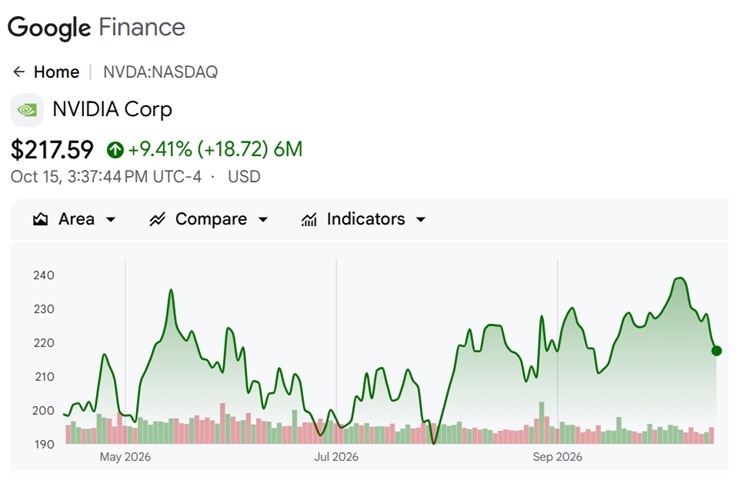
Major AI companies such as Microsoft, Google, META, and Nvidia haven’t suffered big losses, yet the Nvidia stock chart clearly shows the nervousness of investors in that key AI stock in the last 6 months. That volatility might not change in the next 6 months.
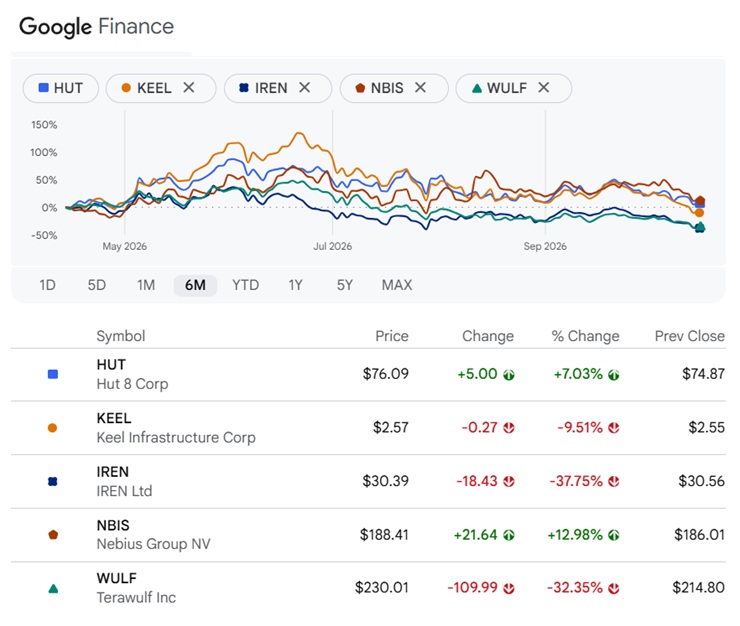
Smaller high-potential small cap firms such as Keel, Iren, Hut 8, Nebius, Terawulf, Lumentum, and Vertiv have taken big price hits. Investors have clearly bailed out. Worse, everything announced about them is turned into a negative by the financial media outlets.
But let’s cut to the chase – the holy grail for you as a risk on investor during a big market dip, is to find those stocks with the biggest rebound potential. Will it be IREN with its more financially and client based strengths, or is it the upside with HUT 8 or Keel Infrastructure?
Which AI Infrastructure Stocks Will Rebound Better?
Your big opportunity is found in the question: which AI stocks will rebound the best? Below, in the chart, we get a view of how they might rebound. Likely they’ll all rebound similarly when this current crisis ends. And it will end.
This chart or this information is not intended as investment advice. These stocks are risky.
However, in diving in deeper into this opportunity, you’re more educated about it than many others who might buy tech stocks.
My point is that these particular AI infrastructure stocks are severely undervalued and thus may be very investible. Some of them such as Keel and Hut 8 have fewer established customers thus are more speculative. The supposition is that they will win those customers when the macroeconomic environment regains its footing in 2027.
Right now with inflation, Iran war and mid-terms, uncertainty is high. No one is sure of the outcome. But we know President Trump has some power and has proven to be resourceful to support US business and those investing in the US economy.
Rebound Profiles Across the AI Stack
The table below outlines how these stocks compare based on their financial profiles and potential mathematical upside required to reclaim their recent 52-week highs.
| Ticker | Sub-Sector / Profile | Structural Catalyst for Rebound | 52-Week High | Current Price | Required Rebound Upside |
| TeraWulf (WULF) | Power/Data Center | Zero-carbon power sourcing, high execution on HPC hosting conversions. | $29.84 | $11.54 | +158.6% |
| IREN | Neocloud / Data Center | Vertically integrated site ownership; multi-year GPU contract pricing power. | $52.92 | $30.56 | +73.2% |
| Vertiv (VRT) | Thermal & Power Hardware | Liquid cooling monopoly risk; massive enterprise/hyperscale backlog. | $379.94 | $222.83 | +70.5% |
| Keel Infra | High-Voltage Power & Core AI/HPC Infrastructure | grid ownership, multi-billion-dollar scale, and heavy liquidity, and interconnected power capacity | $7.37 | $2.55 | +189.0% |
| Hut 8 (HUT) | Power/Data Center | Diversified managed services and legacy power capacity monetization. | $140.80 | $74.87 | +88.1% |
| Nebius (NBIS) | GPU Neocloud / Clusters | Massive quarterly revenue scale-ups (+454% YoY) and cluster rollouts. | $299.86 | $186.01 | +61.2% |
| Lumentum (LITE) | Optical Components | Photonics/transceiver breakout driven by hyper-dense cluster optics. | $1,143.00 | $896.33 | +27.5% |
Macro Rebound Analysis by Tier
- The Power-Constraint Players: TeraWulf, IREN, & Hut 8
- The Profile: These companies transitioned from bitcoin mining to AI data centers because they control the rarest resource in AI: interconnected, high-voltage power substations.
- Rebound Thesis: High beta, high velocity. They fell hardest due to the massive capital requirements to build out data center shells. However, TeraWulf and IREN have the sharpest coil effect because hyperscalers are desperate to lease land with ready-to-go power.
- Key Risk: Stock dilution to fund the capital expenditures (CapEx) before regular AI leasing revenue starts flowing.
- The Bottleneck Monopolies: Vertiv & Lumentum
- The Profile: Physical suppliers of critical AI components. Vertiv owns the market for data center liquid cooling, while Lumentum makes the high-end optical components needed to connect thousands of Nvidia chips.
- Rebound Thesis: Highest fundamental safety. Unlike neocloud firms, Vertiv and Lumentum are already generating real, highly profitable cash flows. Vertiv’s forward EPS target of $6.65–$6.75 shows that even if cloud providers struggle, the demand for hardware remains red hot. Lumentum has broken technical moving average resistances quickest, implying that institution money uses these pullbacks to buy high-conviction hardware.
- Key Risk: High trailing valuations (Vertiv trading over 49x earnings) leaves little room for any delivery delay.
- The Pure GPU Operators: Nebius
- The Profile: Pure-play AI cloud layer. They buy chips from Nvidia, hook them up, and lease the compute out to enterprises.
- Rebound Thesis: Hyper-growth narrative. Nebius carries a massive consensus price target among bullish firms (~$283–$300) because its revenue growth is essentially vertical (+454% YoY). If interest rate fears subside, Nebius can snap back immediately.
- Key Risk: Intense competition from hyperscalers and massive capital layout costs to buy the latest generation of chips.
The 4 month sell off has been steep powered up by the AI company’s soaring capital demands and macroeconomic friction. Neither seem to be abating, but smart, progressive investors still believe AI is the holy grail.
I’m not advising a purchase of AI stocks, but if you have some extra “gambling cash” this is way better than buying powerball tickets.
Even if these stocks grow 100% of their current value, or should reach their previous highs during a strong 2027 economy powered by lower energy costs, then you’re looking at a sizable gain. In my estimation, these stocks are the only ones that will return such megasized ROI.
The real center of the opportunity comes with the power bottleneck where stocks like IREN, Keel, Terawulf, and HUT 8 are positioned with their big power generation potential. When the economy heats up but power availability and price become problems, these are the only companies that can ease that pain. At some point, you might see them rise to unbelievable values. If they don’t, you likely still retain the value of your investment. Right now, oddly enough is the least risky time to buy them.
See more on the 2027 stock market forecast.