Stock Market Year-End Rally 2026: Will Santa Claus Save Wall Street?
Can the S&P 500, Dow Jones, NASDAQ and Russell2000 rebound before Christmas? Five Wall Street forecasts, the history of Santa Claus rallies, and the risks investors should watch.
We likely still remember Fundstrat’s Tom Lee’s year end rally a few years ago, nailing it dead on at 4795, perhaps the most historic prediction of recent. This year, to end it off, many analysts are predicting a year end rally, and you can view their forecasts below. Tom said recently himself, that the AI stock sell off was very near, but he might have been surprised by the speed and volume of this last avalanche of selling AI stocks.
The term Santa Claus rally was coined back in 1972 by Yale Hirsch, the founder of the Stock Trader’s Almanac. He defined the time period of the SCR to be the final 5 trading days of the year to the first two trading days of the following year. These seven days have historically shown higher stock prices 79.2% of the time, reflected in the S&P 500 index.
The Stock Trader’s Almanac compiled data from 1950 through 2022. It revealed a Santa Claus rally happened 58 times (80% of the time), and resulted in a 1.4% growth in the S&P 500.
Wall Street investors are hoping for an extraordinary Christmas present this year: a powerful stock market rally that reverses recent losses and carries the S&P 500 toward 8,000 or higher. But Santa Claus has considerable work to make this happen.
On November 5, the S&P 500 plunged 4.4% to 7,353.73, while the Nasdaq dropped approximately 5.5%. The selloff renewed fears about AI valuations, spending on data centers, inflation, and the sustainability of the bull market. On November 6th, a small reversal is underway, but how full hearted can it be given the negativity that flooded in due to the Democrat House/Senate election win? It will take a few weeks for reality to settle in, and then what will the verdict be on the 2027 stock market outlook?
Despite the turmoil, several prominent forecasters, including Tom Lee of Fundstrat and Mike Wilson of Morgan Stanley, continue to anticipate a year-end recovery.
What Is the Santa Claus Rally?
The Santa Claus rally is a historical tendency for stock prices to rise during the final five trading days of December and first two trading days of January.
Yale Hirsch, founder of the Stock Trader’s Almanac, identified the pattern in 1972. For the 2026 holiday season, the official Santa Claus rally runs from December 24, 2026, through January 5, 2027.
A broader year-end rally might begin in November or early December, driven by earnings, interest-rate expectations, institutional buying, and improved investor sentiment. It’s important to consider the current mood of fear in the investment community. A war, uncertain FED, and political battles are going to factor into investor optimism. Then there’s the question of what is considered a rally? Is 10% or 20% the required number, or just a year end pick up?
How Often Does the Santa Claus Rally Happen?
According to historical market data extending back to 1950, the S&P 500 has risen during approximately 76% of Santa Claus rally periods, producing an average gain of about 1.3%. By comparison, ordinary seven-session periods have generated positive returns approximately 58% of the time.
Something for investors to know however, is that a few unsuccessful Santa rallies have preceded serious market declines, including those associated with 2000 and 2008. The traditional Santa rally failed in three consecutive periods ending in January 2024, January 2025, and January 2026. The declines were approximately 0.88%, 0.53%, and 0.11%, respectively.
Yet, Santa Claus rallies happen within market trends, with all their balancing acts over time. The Stock Trader’s Almanac reports that the S&P 500 still finished higher in 12 of the 17 calendar years following negative Santa rally periods since 1950.
All of these historical events are meaningful, not as a warning for enthusiastic retail investors or a guarantee. And when experts make these bold calls, you might think of it in terms of entertainment.
Nine Reasons Why Santa Claus Rallies Happen
Why would investors become enthusiastic buyers during the quietest trading days of the year?
Several explanations have emerged from decades of market research:
- Institutional portfolio adjustments: Fund managers rebalance holdings and may purchase favored stocks before reporting year-end positions.
- Holiday optimism: Positive sentiment and expectations for a prosperous new year may increase investors’ willingness to take risks.
- Year-end bonuses: Investment bonuses and other cash distributions can provide additional capital for equity purchases.
- Tax-loss harvesting: Investors sell losing positions to realize tax losses, sometimes followed by reinvestment in other securities or renewed buying after year-end.
- Self-fulfilling expectations: Investors anticipating a Santa rally may purchase shares early, contributing to the price increases they expect.
- Reduced institutional trading: Holiday vacations produce lower trading volumes, allowing relatively modest buying activity to push prices upward. However, selling can also produce outsized losses.
- Strong holiday consumer spending: Encouraging retail sales can reinforce confidence in consumer-oriented companies and economic growth.
- The January Effect: Some investors anticipate improved demand for smaller-cap stocks as the new investment year begins.
- Fresh investment allocations: Portfolio managers and individual investors position capital for anticipated opportunities in the coming year.
None of these theories independently explains every Santa rally. Together, however, they help clarify why market psychology, liquidity, and seasonal investment behavior can become unusually influential.
Tax note: U.S. wash-sale rules generally prevent investors from immediately repurchasing substantially identical securities while deducting the associated loss.
Will There Be a Year-End Stock Market Rally in 2026?
There are compelling arguments on both sides. Yet, the market correction yesterday, led by the selloff of AI stocks, actually helps support a late year rally for the Dow Jones, S&P500, NASDAQ and Russell2000.
The bullish case rests on continued corporate earnings growth, the economic benefits of AI infrastructure investment, the potential for oversold technology shares to recover, and renewed buying following the November midterm elections. There is a strong anti-AI theme being bandied about and its presented as a “profitability issue.” Given the political pressure to focus on any negatives or dealys in gratification of AI investing, any rally will have to overcome those headline issues. And the matter of AI regulations is likely the cause of the market crash yesterday. It’s going to cloud the road ahead for the coming week, the next 3 months and will impact any expert stock market forecast.
Morgan Stanley and Fundstrat both see opportunities for stocks to recover as political uncertainty clears, but will politicall uncertainty actually grow?
However, the bearish case is equally important. Elevated interest rates, expensive stock valuations, energy-price shocks, and concerns about the financing of AI infrastructure could suppress investor enthusiasm.
There is also the possibility that technology stocks have entered a longer valuation adjustment rather than a temporary correction. A Santa Claus rally would be welcome, but investors should first evaluate whether the underlying conditions for a sustainable recovery are improving.
Five Wall Street Experts’ Year-End Stock Market Forecasts
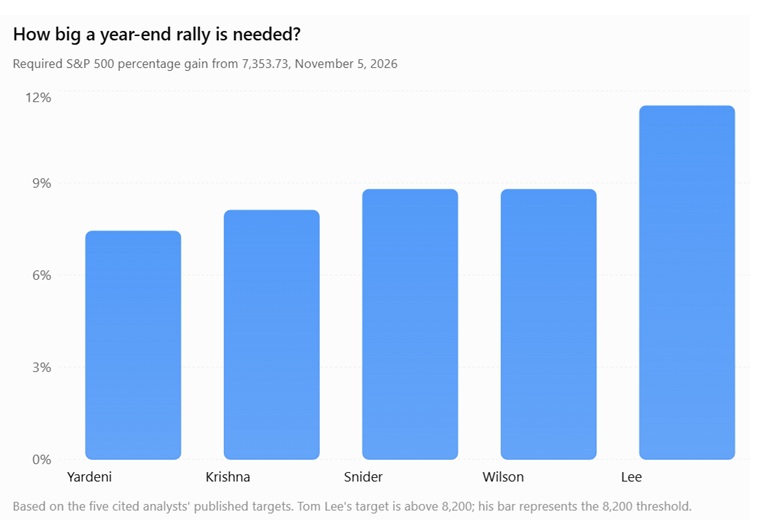
The following forecasts illustrate how much recovery investors may need to see before December 31.
| Analyst / Firm | 2026 S&P 500 target | Gain needed from Nov. 5 | Forecast rationale |
|---|---|---|---|
| Tom Lee – Fundstrat | Above 8,200 | Over 11.5% | Believes technology stocks can recover strongly as AI demand remains resilient. Nov. 3. |
| Mike Wilson – Morgan Stanley | 8,000 | 8.8% | Anticipates post-election recovery, potentially following further near-term weakness. Oct. 27. |
| Ben Snider – Goldman Sachs | 8,000 | 8.8% | Maintains an earnings-led bullish forecast while acknowledging slower growth. Oct. 19. |
| Venu Krishna – Barclays | 7,950 | 8.1% | Strong corporate earnings and continued AI spending support further gains. Sept. 9. |
| Ed Yardeni – Yardeni Research | 7,900 | 7.4% | Remains constructive on earnings but has lowered his target because of interest-rate and geopolitical risks. Oct. 24. |
Targets are published forecasts, not guarantees. Required gains are calculated from the S&P 500’s November 5 closing level of 7,353.73. Analyst estimates may change.
An October Bloomberg survey of 19 equity strategists produced an average year-end S&P 500 target of 7,967. See other stock market experts outlooks. and keep up to date on the stock market frequently to gain more insight into the sentiment that might precede a rally or perhaps a correction. Whoever engineered this recent demand for soon profitability from the AI companies obviously has some power.
This illustrates the market’s dilemma: earnings forecasts remain optimistic, but current equity prices reflect considerably greater uncertainty.
What Could Prevent a Santa Claus Rally?
The threats are similar to any that would threaten the US economy. The biggest threat is that inflation and elevated borrowing costs make investors unwilling to pay premium valuations for growth stocks. Further, if the Democrat led house and senate put the kaibosh on AI growth with crippling regulations and threaten higher taxes, it will dampen enthusiasm for investment.
Oil-price increases, geopolitical conflict, a more restrictive Federal Reserve, or deterioration in credit markets could prolong the correction. AI infrastructure stocks face an additional challenge: investors are becoming more demanding about the financial returns on enormous capital expenditures.
What Should Investors Watch Before Christmas?
Watch whether the Nasdaq stabilizes and whether the recovery spreads beyond the largest technology companies.
Improving market breadth, rising earnings estimates, steadier Treasury yields, and stronger performance from industrial, financial, and small-cap stocks would strengthen the bullish case.
A rebound driven by only a handful of speculative AI shares would be less reassuring.
Investors should also watch the Federal Reserve’s December policy announcement, inflation reports, and developments affecting oil prices and AI infrastructure investment.
Should You Buy Stocks Before the Santa Claus Rally?
The temptation to buy heavily after a steep selloff is understandable. I’m sure you wouldn’t mind cashing in on the year end rally if it could happen. Of course, that might also mean buying into this current dip, especially in what are now speculative AI stocks.
My view on this is that the AI infrastructure stocks are foundational to the US economy, so the question is only which are the best stocks to buy and which AI stocks are likely to excel through the late 2026 turbulence and the political struggles ahead. Investors feel stocks such as Keel, IREN, Nebius, Vertiv, and others are vulnerable to the Democrat attack on AI. The bottleneck may never happen. Regulations mean a cap is on the upside and raises the risks for failure. Artificial influence always threatens the natural growth of companies, sectors, industries and countries. Overcoming this negative influence will be a challenge for investing going forward and for any late season rally in 2026/2027.
Long-term investors might find opportunities in profitable companies with strong cash flows, sustainable competitive advantages, and reasonable valuations. Short-term traders need to recognize that thin holiday trading can amplify losses as easily as gains.
The most promising Santa Claus, year ending rally scenario is an earnings-supported rebound that broadens beyond technology, carries through December, and continues into 2027. But if the economy slows, earnings will likely take a slip and the rally is questioned.
See more on the outlook for the 2027 stock market and what the view is like for the week ahead.