

Lower Immigration is the Solution to Canada’s Housing Crisis
According to some political sources, Canada needs more immigrants. Yet that unvalidated claim and contentious issue for Canadians themselves, doesn’t include housing, social services, and jobs for the waves of migrants.
For the immigrants themselves, their arrival is painful. There is nowhere to go, their language skills absent, and some end up homeless — just like Canadians. The idea that Canada needs more immigrants is purely political — to bring in more votes for the governing party — The Liberal Party of Canada. It’s not working for Canadians. Everyone is stressed out.
And that’s where the Liberal Party’s magic and vacuousness enter the picture. The crux of Canada’s economic, social, cultural and debt problems arrives solely through pulling in far more immigrants than the country can handle. The numbers are obvious. Millions of immigrants can’t be sustained, even if they were highly educated and qualified to participate in the new era of work in Canada.
More Isn’t Better: More is Diasastrous
The old political style mantra of more is better is actually creating a financial crisis for the current Liberal government — from bloated payrolls, unwise spending, debt interest payments, and an anti-Canadian sentiment that Canadians are increasingly fighting back on. The Liberals also want to fight President Trump on trade issues, and stubbornly refuse to give in small concessions related to “supply management” in Quebec and Ontario. This issue threatens to topple the entire country, including the separation of some provinces.
There is a clear path to a Workable Solution: cut immigration, resolve the trade deal, end harmful regulations on Canadian companies, and adopt a pro-small business policy to support the real source of employment in Canada. We have a clear path to an easy solution, but it will have to be implemented by the Conservative Party led by Pierre Poilievre.
Will Cutting Off Immigration Help?
We have the question to answer: will ending immigration ease the housing crisis? A report from RBC says it will help.
Ottawa estimates that slashing targets for permanent residents and reducing the number of non-permanent residents by more than 900,000 over two years will result in the population falling by 0.4% by 2026. It will start to grow slowly from 2027 onwards. — RBC Report on Immigration Cuts.
RBC acknowledges however, that the issue is so severe that reducing immigration won’t solve the housing crisis, just ease it. We’re stuck with a glut of foreigners who now face limited job prospects. The value of coming to Canada was never really there. It was just a promotional campaign designed to pull in new voters. It’s a massive problem most don’t want to think about but if we don’t stop immigration (2026 planned importation remains at 380,000), it makes any plan useless.
Ideologically-Driven Immigration Designed to Eliminate All Possible Solutions Ahead of Time
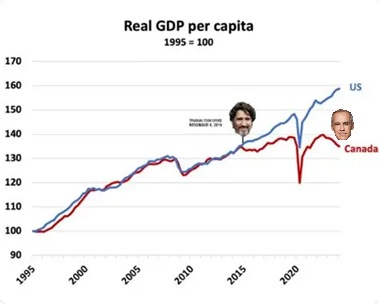
The title graphic above (courtesy of the Fraser Institute) shows clearly how out of control the Liberal Party’s quest to draw in migrants was, even though there were no jobs, housing or social programs for them. It was a vote building scam to help the Liberals win future elections. This is a tactic that should be made illegal via proper federal legislation.
And to note, some feel the Liberals obsession with anti-hate legislation is a front for quashing resistance to their political aims.
The greater part of this economic catastrophe began with the election of Justin Trudeau in 2015, where Canada’s economic decline accelerated. That decline happened even though the Liberals began printing and spending money at alarming rates. Further, they implemented regulations that discouraged home building and raised the cost of energy, food and taxation. The Covid era not only saw huge increases of mass immigration but also stimulus spending that Canadians are still trying unsuccessfully to cope with.
Food bank dependence has grown exponentially, especially among the employed.

 Few argued against it or tried to stop the immigration surge. Many homeowners/investors rode the gravy train of higher home prices (greed) despite the harm it’s done to Canadian society, taxes, affordability, inflation, marginalized people, social and health care programs, and government debt loads. Getting the dream price became the mission and local municipalities responded with more resistance to home building and outlandish development fees and regulations.
Royal Lepage Forecast: Canadian Home Prices up 1% in 2026
Despite the Canadian economic picture being so gloomy, Royal Lepage’s prediction on the Canadian housing market is surprisingly okay. They project overall Canadian home prices will rise 1% on average over 2026.
That might come as a surprise to many who are seeing prices plunge in Toronto and Vancouver. But as Royal Lepage’s report reveals, home prices have been a regional phenomena. Some cities in Alberta and Quebec were seeing big increases. If President Trump’s quest to lower oil prices, and import heavy crude from Venezuela pan out, Alberta’s GDP could be in for a significant hit. $40 oil with lower exports also means lower tax revenue for Ottawa.
The Real Problem in the Housing Market is Immigration, Period
A Financial Post report from Herbert Gruel says Canada’s population increased 1.1% per year on average from 1980 to 2022. Then in 2023 and 2024, it rose 2.9% 3.0% respectively — almost three times that rate.
Charts show the swelling of incoming migrants even though Canada’s economy can’t sustain it in jobs or housing. The financial cost of the Liberal Party’s draw in of foreigners has resulted in significant ballooning of the national debt and erosion of Canadian institutions.
The Liberal’s are trying to solve the issue with a promise of increasing the building new homes from today’s rate of 250,000 a year to 500,000. The number is laughably silly given it’s not sustainable or even achievable in financing, labor or supply of materials. Current housing zoning further prevents any such growth in new homes. Importing construction workers only makes the problem worse.
Bloated politically-generated projections of new home building serve to draw Canadians attention away from the source of the housing problem – excessive immigration.
With the Liberals promising even higher immigration amounts (500,000 in 2026), their construction program would soon fall short. Fact is, the problem wouldn’t go away because demand from immigrants soaks up anything that’s built. Yet, most of the immigrants are poor, initially unemployed, and will need help to find housing and establish themselves.
Research shows immigrants, including so called refugees receive substantial financial assistance for food, housing and other expenses. The volume of immigrants too is hard to comprehend, in what is really an “open borders” government policy.
The mass immigration push by the Liberals, is of course, a draw in of future Liberal voters. Recent studies show immigrants vote Liberal (61%) which is likely a watered down version. Because the Progressive Conservatives offer lower immigration of family members, no financial support, and would remove the “Canadians last” theme that’s been in Federal management for the last 10 years.
Save Your Country: Canadians Need to Put their Foot Down on Immigration
The final verdict on heavy mass immigration is that it must stop. By doing so, we can remedy the housing availability and affordability crisis over the next 5 years. We can ease the health care crisis, lower inflation, reduce government deficit spending, and free up housing for current Canadian citizens, many of whom have worked and paid taxes for 3 to 5 decades.
The Liberals “Build Canada Homes’ project is not financially feasible nor will generate results soon enough – spread over 10 years when people need housing now. We need a now solution – and ending immigration is the right move.
Sure big corporations will complain if they can’t get cheap labor paid in CAD pesos, and they’re a part of the Canadian problem. However, reports have it that skilled foreign workers are actually leaving Canada due to the deteriorating economic outlook. If they’re gone, who exactly are we left with?
And as AI unemployment and trade related unemployment increases, what will the government do with these perpetually unemployable people?
The Financial Post also reported today that Canada’s unemployment rate rose .3% to 6.8% during December, vs November, as the number of Canadians looking for work spiked, outpacing modest job growth.
With Liberals not working cooperatively with President Trump to resolve the USMCA trade crisis, the last half of 2026 could be even more grim for Canada’s economy. This would discourage further home building as builders run away from the risk of building during a deepening recession, despite lower mortgage rates.
The fact is, Trump doesn’t like Carney or the WEF/Woke Liberal Party and will likely remain tough or rejecting as long as they’re in office. Another FED election is needed, soon, this year. However the PCs may not be ready. They’re proposition is either missing or weak, and for immigrants, not palatable. Thus we could be stuck with the Liberals for 3 more years.

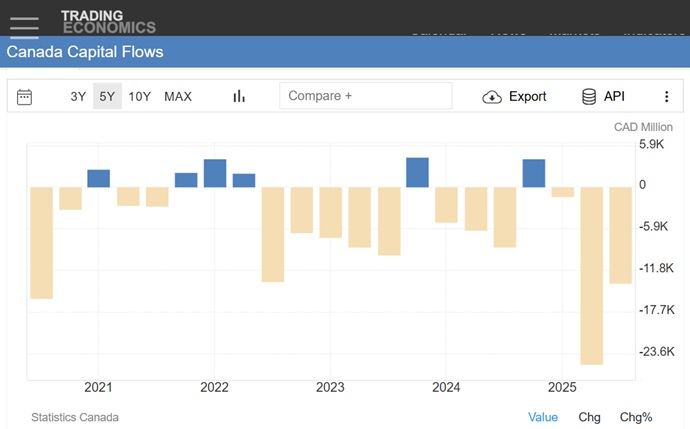
Foreign investment in Canadian securities has plunged 60% so far this year – The Logic
The Logic report revealed Canada saw a net outflow of nearly $62 billion—the steepest since the pandemic.
Next Steps for Canada
The key progress is in recognizing that out of control, irresponsible, immigration for votes is unacceptable and should be outlawed. Canadians don’t deserve to be treated this way, and we must pressure our MPs to put a stop to it.
It does come down to self-respect and self-esteem, and the knowledge that we as Canadians deserve a better lives, and the next generations too deserve a chance at a decent life. We all know “the rich get richer and the poor keep growing” is one of our top national threats.
There will be no home ownership, pension plans, pleasant retirement, and lower enjoyment of life for most Canadians in the years ahead. It’s up to us to turn this around. Get active and do the right things for yourself and your country.
See more on the Toronto housing market.