Forecast 2027: Is their Hope for Buyers and Investors?
Home Prices, Mortgage Rates, Sales and the Best Markets to Buy
For those homebuyers still hoping an affordable moment happens in the next 5 years, the U.S. housing market may finally change in 2027.
It might not happen in the way millions of prospective buyers dream of.
More new home listings may become available for sale and home builders should continue adding new inventory. Some homeowners who have spent years holding onto extraordinarily cheap mortgages will finally move and some will buy baby boomer’s properties as these aging Americans begin to make changes in their lives.
Buyers in several large metropolitan markets should have considerably more negotiating power.
Yet none of the above should be taken to mean the housing market forecast is for cheaper housing.
Mortgage rates are likely to remain well above the ultra-low levels Americans became accustomed to before 2022. Property taxes, insurance, maintenance, construction costs and household debt remain significant. And after years of underbuilding, the United States still has an underlying housing shortage.
What is the Overall Prediction for 2027
The housing market should become easier to transact in, but not necessarily much easier to afford.
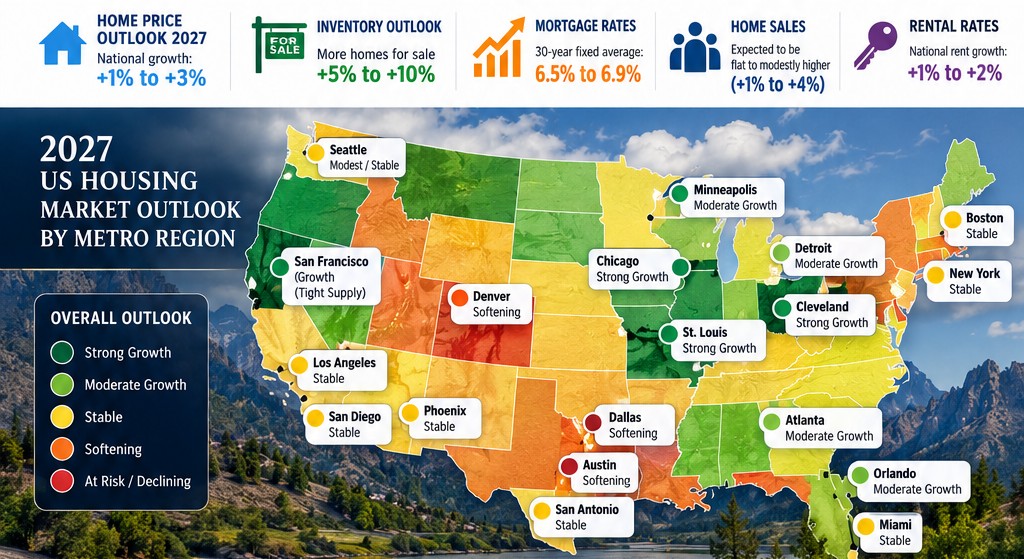
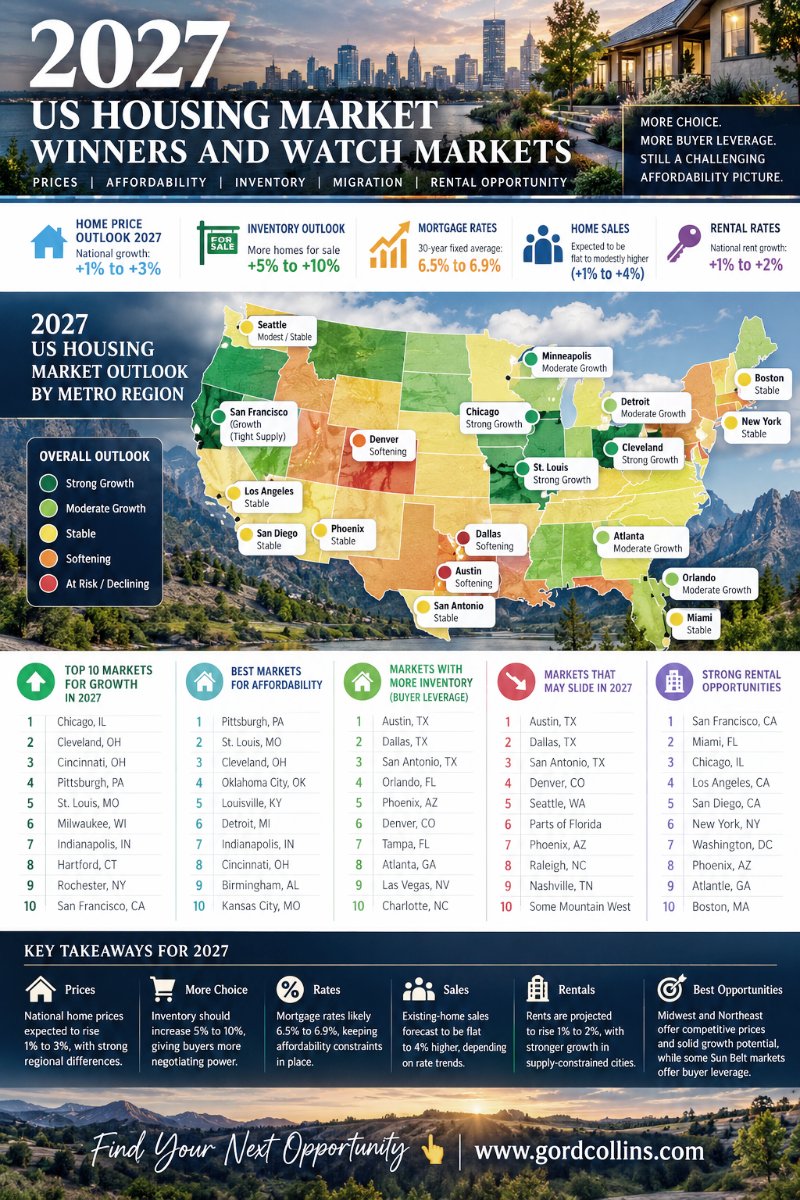
It will also become increasingly regional. Some Midwest and Northeast markets could continue producing healthy price growth, while heavily supplied markets in Texas, Florida and parts of the Mountain West may see buyers being offered discounts and negotiating opportunities.
2027 US Housing Forecast at a Glance
The forecasts from Fannie Mae, Zillow, J.P. Morgan and more than 100 experts surveyed in Fannie Mae’s Home Price Expectations Survey suggest gradual national growth. Fannie Mae currently forecasts 4.215 million existing-home sales in 2027, up 3.8%, total housing starts of 1.327 million, a 6.7% average 30-year mortgage rate and just 1% home-price growth. Its broader expert panel expects 2.2% price growth, while J.P. Morgan expects approximately 3%.
| Housing factor | The 2027 base-case Outlook |
| National home-price growth | +1% to +3% |
| Existing-home sales | 4.1–4.25 million |
| Sales growth | roughly +1% to +4% |
| 30-year mortgage rate | roughly 6.5%–6.9% average range |
| Total housing starts | about 1.30–1.35 million |
| Single-family starts | about 900,000–925,000 |
| Active for-sale inventory | +5% to +10% possible |
| National apartment rent growth | roughly +1% to +2% |
| Overall market | Slow normalization, major regional divergence |
* Estimate is a synthesis of findings: Zillow reported 1.39 million homes for sale in September 2026, 2.5% above a year earlier, while Realtor.com says its inventory measure has moved to within 9.1% of its pre-pandemic norm. That’s an improvement on the market we saw several years ago.
US Home Prices in 2027
A national housing-price crash is not in the cards, nor is a housing boom. The price forecast for 2027, is an increase of about 1% to 3%.
There is good support for that range. Fannie Mae’s September housing forecast predicts its home-price index will increase just 1% in 2027. Its separate Home Price Expectations Survey of more than 100 economists and housing experts produces a higher average forecast of 2.2%. J.P. Morgan Global Research expects about a 3% rise in prices.
Regionally, price momentum is strongest in parts of the Midwest, Northeast and Northern California. Redfin’s August repeat-sales index showed year-over-year gains of 9.2% in Chicago, 7.5% in Cleveland, 7.3% in Cincinnati and 12% in San Francisco. The cities with the downtrend are Dallas, Austin, Fort Worth and San Antonio which were already experiencing annual declines.
Realtor.com’s newest October research reflects the geographic shift. All of its 20 hottest housing markets of September were either in the Midwest or Northeast. Kenosha, Wisconsin ranked first, followed by Hartford and Rockford, while Rochester and several other relatively affordable markets remained exceptionally competitive.
For 2027, we may see Chicago, Cleveland, Cincinnati, Pittsburgh, St. Louis, parts of Wisconsin, western/upstate New York, Connecticut and selected New York suburbs on the price-outperformance list. San Francisco and San Jose deserve a separate category. They remain extraordinarily expensive, but tight supply and AI-related wealth creation could continue generating above-average appreciation. That market is more economically sensitive and volatile than the Midwest, however.
Which Housing Markets Could Slide in 2027?
The weakest markets may not necessarily experience large crashes. More likely, they will spend 2027 correcting through flat prices, seller concessions, longer listing periods and modest nominal declines.
Texas deserves particular attention. Redfin estimates sellers already exceed buyers by 115% in Austin and 108% in Dallas; San Antonio is similarly buyer-favored. Dallas prices were down 1.4% year over year in Redfin’s August index, Austin 1%, Fort Worth 0.7% and San Antonio 0.4%.
Austin, Dallas–Fort Worth, San Antonio, Denver and Seattle are among the markets most at risk of another weak pricing year.
Certain Florida markets are more complicated. Migration remains strong, but housing expenses increasingly include high insurance, HOA and maintenance costs. Miami, Tampa, Orlando and parts of southwest Florida also have considerably more for-sale supply than constrained Northeast markets.
That could create excellent purchasing opportunities—but it does not automatically make those markets appreciation leaders.
Home Sales Could Finally Begin Recovering
Here the forecasters disagree.
Fannie Mae forecasts 4.215 million existing-home sales in 2027, up 3.8% from 4.062 million in 2026. New-home sales are forecast to grow 5.9%, taking total U.S. home sales to 4.882 million.
Zillow is noticeably more pessimistic. With mortgage rates having climbed sharply again this fall, Zillow says high borrowing costs have brought an “early winter” to housing and believes home sales are likely to dip during 2027.
If mortgage rates drift down toward 6.5%, transactions should begin recovering. If they remain near today’s 7%–7.5% range, sales could remain stuck near historically low levels.
Supply-rich markets such as Dallas, Austin, Phoenix, Denver, Atlanta, Charlotte, Orlando and San Antonio could produce improving transaction volumes because buyers actually have homes to choose from—even while their prices remain flat. Low supply markets such as Chicago or New York could produce stronger price appreciation without equally strong sales growth because there simply aren’t enough homes available.
Affordability: Where Buyers Have a Better Chance
National affordability remains poor. Zillow estimates a median-income household currently must devote 34.3% of income to the typical ownership payment once estimated taxes, insurance and maintenance are included.
Affordability is more evident in a number of cities and regions. Redfin found that the typical household could afford the median-priced home in only 12 of America’s 50 largest metropolitan areas: Pittsburgh, St. Louis, Cleveland, Oklahoma City, Louisville, Detroit, Indianapolis, Cincinnati, Birmingham, Minneapolis, Baltimore and Kansas City.
Pittsburgh and St. Louis combine housing costs below national averages with established employment bases. Cleveland, Cincinnati and Indianapolis offer relatively attainable entry prices. Kansas City and Oklahoma City offer similar affordability advantages.
Those markets do not need spectacular population growth for good opportunities for buyers and investors. If wages are sufficient to support a mortgage and construction remains limited, modest demand can sustain home prices and rent prices surprisingly well.
The 2027 housing opportunity may therefore migrate away from the glamorous coastal metros toward what could be called America’s affordable economic cities.
More Inventory Should Reach the Market
Expect 2027 to produce another meaningful increase in homes available for sale via:
- the mortgage-rate lock-in effect
- moves because of marriage, divorce, children, retirement, job changes, inheritances and health.
- Demographic changes.
Realtor.com estimates approximately 1.27 million homes occupied by older Americans could be released from owner occupancy during 2027 as part of the gradual generational housing transfer. Not all will be listed for sale, but Realtor.com calculates that if 45% entered the for-sale market, they would by themselves be enough to restore annual listings to pre-pandemic levels, all else equal
This means we can expect US active inventory to increase another 5% to 10% during 2027, although the increase will be extremely uneven.
Texas, Florida, Arizona and parts of the Southeast should offer substantially more choice than New England, New York and many Midwestern markets.
America’s Housing Shortage Isn’t Going Away
NAHB estimates the United States still has a structural shortage of approximately 1.2 million homes. It identifies five major constraints on production: labor, lots, lumber and other building materials, lending, and legal/regulatory barriers and that means rising prices.
Construction itself remains expensive. NAHB reported almost 300,000 construction-sector job openings late in 2025 and estimated residential construction must attract roughly 740,000 workers annually simply to accommodate growth, retirement and normal workforce turnover. Building-material prices have also risen.
Regulation is another major issue with cost and supply problems. An NAHB study estimates federal, state and local regulatory requirements now account for $131,734, or 26.4%, of the average price of a new single-family home. That is an industry estimate rather than an independent government calculation, but its direction is important: permitting, land-use restrictions, development fees and building requirements have become substantial components of housing cost.
Fannie Mae does not foresee a construction boom. They expect total housing starts to decline 1.8% in 2027 to 1.327 million units. Single-family construction should improve 1.4% to 909,000 units, but multifamily starts are projected to fall 8%.
That means the housing shortage will continue, which may be good news for multifamily investors.
Migration Will Keep Reshaping Housing Demand
American home buyers persist in the preference for affordable homes. Yet, migration and limited construction will likely be the price driver in many areas.
Redfin found that 19% of its house hunters searching during the second quarter of 2026 were looking outside their current metro area. Las Vegas ranked first for net inbound interest, followed by North Port, Orlando, Miami, Sacramento, Cape Coral, Tampa, Myrtle Beach, Spokane and San Antonio. Los Angeles, New York and Seattle experienced the greatest net outflows.
Those selling their million-dollar coastal house receive a big bonus in purchasing power by moving inland. Yet the reality of US migration is changing.
The popular narrative of “everyone moves to Texas and Florida and prices go up” is no longer sufficient. Builders responded aggressively to population growth in some Sun Belt metros. Texas with its supply, lets buyers there enjoy population and employment growth while experiencing softer home prices.
The Regional Economic Outlook for Housing
The Federal Reserve expects national real GDP to grow 2.4% in 2027, unemployment to average about 4.1%, and PCE inflation to fall toward 2.3%. That is not a recession forecast. But September payroll growth slowed to just 29,000 jobs, leaving housing vulnerable if employment weakens more sharply.
| Region | 2027 housing/economic Outlook |
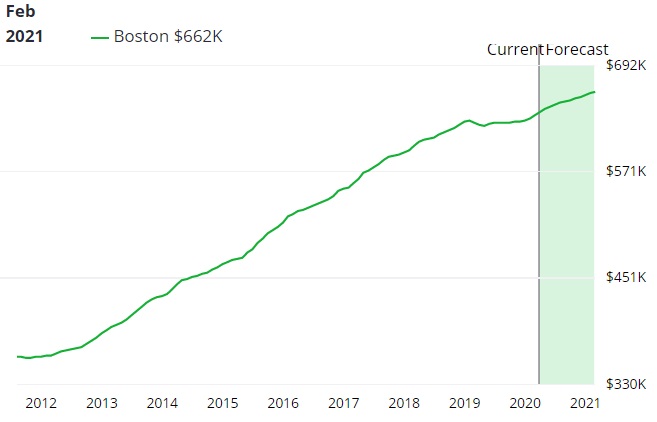
| Northeast | Generally constructive for home values. Limited supply around Boston, New York and many smaller Northeast cities should support prices. High taxes and extreme affordability remain constraints. |
| Midwest/Great Lakes | Perhaps the most interesting region for 2027. Affordable housing, modest construction and manufacturing/healthcare employment support Chicago, Cleveland, Cincinnati, Pittsburgh, Milwaukee and neighboring markets. |
| Southeast | Still supported by population movement, tourism, logistics and business relocation, but increasingly uneven. Carolinas and Georgia may outperform markets burdened by excess supply or high insurance costs. |
| Texas/Gulf Coast | Relatively healthy economic growth but abundant housing supply. Excellent potential for buyer leverage and eventual sales recovery; less convincing near-term price appreciation. |
| Mountain West | A normalization region. Denver and other pandemic-boom markets remain constrained by affordability and increased supply. Price growth should be modest. |
| Pacific Coast | Highly divided. AI and technology could support Bay Area incomes, prices and rents. Seattle is softer. Southern California remains chronically supply-constrained but extremely unaffordable. |
The Federal Reserve’s latest Beige Book already shows this divergence. Dallas activity was expanding moderately, supported by manufacturing, banking and energy, even as residential housing remained sluggish. Chicago’s economy was growing slightly with improving manufacturing. New York continued modest growth and limited housing inventory. San Francisco’s broader economy was little changed and residential activity weakened, although the technology sector remains an important upside factor.
Rental Market Forecast for 2027
Renters are an increasingly important part of the housing forecast because today’s mortgage market is keeping many potential first-time buyers in rental housing longer.
RealPage expects national effective apartment rents to rise about 1.9% between the third quarter of 2026 and second quarter of 2027. Yardi Matrix is more conservative, forecasting about 1% national multifamily asking-rent growth in 2027.
Local markets will be much different than the national US rental market averages.
Ten Major Rental Markets to Watch in 2027
| Metro | RealPage 2027 rent outlook* | Demand interpretation |
| San Francisco | +3.8% | Tight supply, tech/AI employment |
| Miami | +3.4% | Migration and renter demand despite ownership costs |
| Chicago | +2.0% to +2.9% | Limited supply, solid urban demand |
| Los Angeles | +2.0% to +2.9% | Severe homeownership affordability problem |
| San Diego | +2.0% to +2.9% | High ownership costs keep households renting |
| New York | roughly +1% range | Enormous demand, but high starting rents |
| Seattle | roughly +1% range | Tech economy offset by softer housing conditions |
| Washington, D.C. | roughly +1% range | Stable employment base |
| Phoenix | roughly +1% range | Improving absorption, still working through supply |
| Denver | below 1% | Existing apartment supply keeps pressure on landlords |
*RealPage’s published outlook is Q3 2026 through Q2 2027 and reports ranges for several markets rather than exact full-calendar-year figures. Houston and San Antonio are expected to experience slight rent declines.
There is a notable supply explanation behind those forecasts. RealPage expects approximately 312,000 apartment completions over its coming four-quarter forecast window, while Yardi expects roughly 443,000 multifamily units to be completed during calendar 2027 using its broader methodology. Dallas alone faces substantial deliveries, while new construction is much scarcer in San Francisco, Cleveland, Oakland and several other supply-constrained markets.
Which Rental Property Type Could Perform Best?
It looks like family-oriented single-family rentals and townhomes in affordable, employment-supported metropolitan areas.
The regional jobs factor shouldn’t surprise, although President Trump’s economic plan seems to be building a strong future for growth powered by cheaper energy (when the war ends) and the AI powered economy.
Potential homebuyers increasingly want the space, privacy, yard and schools associated with a house but cannot necessarily afford the big ticket price. Meanwhile, years of multifamily construction have created far more apartment supply than single-family rental supply.
Zillow’s 2026 data already shows the difference: single-family rents have been rising materially faster than multifamily rents. For an investor, that makes a three-bedroom house or townhome in a growing but affordable employment market potentially more attractive than buying a luxury downtown apartment in a metro flooded with new Class A units.
The other interesting category is workforce multifamily housing in supply-constrained Midwest and Northeast markets. New luxury apartments in heavily built Sun Belt markets may still face concessions through part of 2027.
Inflation, Household Debt and the Risks Buyers Can’t Ignore
The Federal Reserve currently expects PCE inflation to decline from 3.7% in 2026 to 2.3% in 2027. That would help household purchasing power, but it does not mean prices return to their old levels. It simply means they would rise more slowly.
Meanwhile, household balance sheets deserve attention.
Total U.S. household debt stood at $18.77 trillion in the second quarter of 2026. Mortgage debt was $13.1 trillion, credit-card balances $1.26 trillion and auto debt $1.71 trillion. HELOC balances reached $459 billion, $142 billion above their 2022 low. Auto and credit-card delinquencies remain elevated.
HELOC growth is particularly interesting because homeowners with 3% mortgages understandably do not want to refinance an entire house at today’s rates. Instead, many are borrowing against their equity through second liens. ICE says home-equity withdrawals recently reached their highest first-quarter level since 2021, with second-lien borrowing at an 18-year first-quarter high.
The fact there are serious concerns doesn’t mean a housing market crash is inevitable (some Americans wish for it). But it does mean some homeowner balance sheets are becoming more leveraged.
Job risk is the more important wildcard. The Fed expects only 4.1% unemployment in 2027, yet payroll growth has slowed substantially. A meaningful employment recession would change this housing forecast quickly because job loss—not high mortgage rates alone—is what normally produces forced selling.
The Fed Probably Won’t Rescue Housing in 2027
The Federal Reserve’s September projections show a median federal-funds rate of 4.1% at the end of 2027—the same median projection as for the end of 2026. Fed policymakers aren’t forecasting a rapid rate-cutting cycle.
Mortgage rates don’t track the federal-funds rate directly, but instead are influenced by longer-term Treasury yields, inflation expectations and mortgage-market spreads.
Fannie Mae currently expects the 30-year fixed mortgage rate to average 6.7% in 2027. Zillow is slightly more optimistic about the direction, expecting the rate to ease to approximately 6.5% by the end of 2027.
That is important because mortgage rates have recently moved the other way. MBA’s October 7 survey put the average conforming 30-year contract rate at 7.49%, its highest level in almost three years.
A reasonable 2027 rate forecast might be around 6.5% to 6.9%, but with volatility. If the FED eases, and the Federal debt interest payments are manageable, we might see a move to 6% mortgage rates which would stimulate home sales and perhaps grow inflation again.
Who Will Have the Lowest Mortgage Rate in 2027?
It’s difficult to know which lenders will generate the best mortgage rate for you. And rates change daily and your offered rate depends on your credit score, down payment, loan balance, property type, location, points, loan program and lender capacity.
The lowest rate for one borrower could come from a credit union. For another it could be an online lender, regional bank or mortgage broker. This is why active rate shopping is wise. Use many different channels and websites. The Consumer Financial Protection Bureau found that home buyers can potentially save $600 to $1,200 a year by getting rate quotes.
Which Mortgage Will Be Most Popular?
The 30-year fixed-rate mortgage should remain America’s dominant mortgage product.
Yet adjustable-rate mortgages should take an unusually large minority share while fixed rates remain high.
MBA reports that ARMs recently accounted for 10.3% of mortgage applications, helped by 5/1 ARM rates around 6.43% compared with 7.49% for a conforming 30-year fixed mortgage in the same weekly survey.
Mortgage buyers like the opportunity to reduce the initial payment today and potentially refinance later. Of course, risk goes up.
Intercontinental Exchange estimates approximately 180,000 existing ARMs will reach their first reset in 2027. Most should be manageable, but approximately 74,000 seven-year ARMs originated in 2020 could face a median monthly increase exceeding $1,000 if they reach reset under ICE’s assumptions.
Even though ARMs will be more popular, fixed-rate financing will remain the safer mainstream choice for buyers intending to own for a long time.
VA borrowers who qualify may continue to obtain exceptionally attractive financing, while FHA loans will remain important for borrowers with smaller down payments. The best product depends on the individual buyer rather than on a national ranking.
Best Housing Markets to Buy in 2027
The “best” market does not necessarily mean the one likely to appreciate fastest.
Homeowners might find affordability, employment diversity, reasonable supply, population stability and the ability to carry the mortgage without relying on heroic future price appreciation makes for good decisions.
That puts Pittsburgh, Cleveland, Cincinnati, Indianapolis, Kansas City, St. Louis and Baltimore high on my 2027 value list.
I would also look closely at Dallas–Fort Worth, San Antonio and parts of Phoenix from a different perspective. Those are not my strongest appreciation forecasts, but the excess of sellers over buyers may allow purchasers to negotiate on price, repairs, closing costs or mortgage buydowns. Buying while a fundamentally viable growth market is temporarily soft can be more attractive than chasing a market after prices have surged.
Chicago is particularly interesting. It is less affordable than Cleveland or St. Louis, but its combination of a large diversified economy, relatively limited housing supply and strong current price momentum gives it a compelling 2027 setup.
And for affluent buyers willing to accept volatility, parts of the San Francisco Bay Area could continue benefiting from AI-driven income and wealth creation.
Is 2027 a Good Year to Buy a House?
For some buyers, the coming year ahead could be one of the better purchasing environments of the post-pandemic period. That opportunity comes from a different combination: more listings, fewer bidding wars in many markets, more price reductions, builder incentives and greater ability to negotiate.
Redfin already estimates there are nearly 58% more sellers than buyers nationally, the strongest buyer imbalance in its data going back to 2013.
And financially secure households may have more negotiating leverage in 2027 than during the last 10 years.
Buyer’s should focus on buying the payment, not the local forecast. A buyer should be comfortable with the mortgage, taxes, insurance, HOA fees and maintenance costs at today’s economics. A future refinancing opportunity should be treated as an upside possibility, not as something required to make the purchase affordable. Rates are sitting near historical highs, but government resistance to lowering them should be noted.
Is Buying a Rental Property Still Wise in 2027?
Yes, but 2027 will punish lazy real-estate investing practices. That habit of buying almost anything with cheap financing, accepting weak cash flow , and assuming that rapidly rising prices will rescue the investment could land some investors in hot water. Becaause, fnancing costs are too high.
Successful rental investors will have to concentrate much more heavily on actual property economics: acquisition price, rent-to-price relationship, vacancy, property tax, insurance, HOA costs, maintenance, capital expenditures, property management and financing.
The benefits of rental housing have not disappeared. A well-purchased rental can still provide current income, mortgage principal reduction, potential long-term appreciation, a partial inflation hedge and diversification from financial assets. Tax treatment can also be favorable depending on the owner’s circumstances, although that requires individual tax advice.
The strongest 2027 setup may be a reasonably priced single-family house or townhome in an affordable employment market where families want to live but many cannot yet purchase.
I would be more cautious about expensive properties producing thin yields and about newly constructed apartment-heavy Sun Belt submarkets where landlords are still competing against large amounts of recently completed supply.
Next Year, You’ll See a Housing Market of Economic Contrasts
The U.S. housing problem in 2027 will not simply be “high home prices.”
It is the accumulation of several but familiar forces.
- Home values increased dramatically during the previous housing boom and have not fallen sufficiently to restore affordability.
- Mortgage rates remain high. Inflation has increased the price of almost everything needed to own and maintain a home.
- Insurance costs have risen sharply in many regions.
- Property-tax burdens and HOA expenses continue increasing for many owners.
- Household credit and HELOC borrowing are expanding.
- Builders face higher labor, land, financing and material costs.
- Regulation and development restrictions make new housing more expensive and slower to produce.
- In most of the country, too few homes in the places where people most want to live (local bidding wars).
Yet the country’s economic fortunes are also separating geographically.
AI, finance and technology wealth can support extremely expensive Northern California and New York markets. Manufacturing and relatively low housing costs are benefiting sections of the Midwest. Energy, logistics and business investment continue supporting Texas even while its housing market digests excess inventory. Migration continues benefiting the Southeast, but insurance costs and new construction increasingly separate winning cities from weaker ones.
That is why there probably will not be one American housing market in 2027.
There will be hundreds of local markets responding differently to employment, migration, construction, affordability and supply. For buyers, that creates opportunity and for home sellers, realistic pricing strategies will prevail. Sellers dream price dreams might be disappointed.
And for investors, wisdom in careful market selection, disciplined financial analysis and a clear understanding of why people will still want to live in that particular place five or ten years from now will determine who benefits from the 2027 housing market.
See more on the US housing market forecast.