

Why Do Canadians Vote for the Liberal Party?
When I asked ChatGPT to help me research the preferences of Liberal voters across Canada, it initially did provide the generalized, left-filtered, excuse-laden explanation you might expect. AI search engines do lean left.
Yet with AI search engines, it’s a matter of pressing them, forcing them to immerse in the topic to uncover hidden and less easily accessed information. Real insight only happens when they must dig and confront their own bias and resolve that.
ChatGPT acknowledged the validity of some of my original thoughts on this issue, saying they’re “well founded.” While I had a view of Eastern liberal voters as being solely focused on their own personal wealth and security, ChatGPT did expose a wide range of other matters this group is concerned with.
Below we take a deeper look at what their issues are and what the vote-breakers might be. I think you’ll get a feel for what Liberals actually stand for and what they find acceptable.
Liberal Media: A Frenzy of Anti-West Sentiment (what does that mean?)
Of course, we know Liberal voters have been exposed to a steady diet of woke, save-the-climate, pro-regulation, pro-immigration, and pro-China values via government speeches and media (CBC, CTV, Global) releases. The media has influence. And that’s eaten away at our cultural identity, lowered our education system, ruined our business investment opportunities,, raised the national debt – and generated out-of-control prices, and diminished employment and business opportunities in Canada.
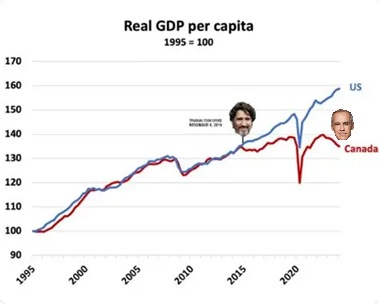
Given the failure of our debt-fueled economy (governments borrowing to the hilt to keep economy alive and to pay massive public salaries) and growing debt-to-person ratio, and lower GDP-per-capita, the fundamentals don’t look good.
None of that has bothered Liberal voters who don’t see a bottom in that pit of despair.
And foreign business is avoiding Canada – no one will invest in this country — unless the government offers free grants. And our small business sector hangs on by a thread while housing is so scarce and expensive that almost everyone fears homelessness now. And is food getting cheaper?
The Most Important Issues to Canadians
So we have this question about why anyone in their right mind would vote Liberal. If PM Carney botches the USMCA trade negotiations, Ontario and Quebec could sink like rocks. He’s taken an anti-US/anti-Trump negotiating stance, that’s going to be very costly in a few months when USMCA discussions resume.
Given voters fear risk of jobs and wealth, the loss of the US market could trigger a massive loss of support for the Liberals. This could be the election issue, and Poilievre’s biggest opportunity to win.
If you review the pollsters, they offer a skewed look at what Liberals want. And pollsters don’t include questions that should be there, such as the national debt, foreign investment, natural resource development, and how much any single province should be taxed to support other provinces. The questions left out tell us a lot about pollsters intent.
The Risk of Losing Another Snap Election is Real
Carney may be considering a snap election, while he has voter support, before Poilievre can recover his popularity. The more Trump says and does, the more support Carney gets from the Liberal voter base. It’s pure self-deceit, and a big issue for all Canadians who face the road ahead.
Just a note on the last election where the PCs and Pierre Poilievre held a 23 point lead over the Liberals, then lost, is that what you’ll read here explains that too. That Canadians have a set of “personal insecurities” that rank above all else, and when they viewed PP as Prime Minister, they saw their “assets” in danger. Not much has changed, other than Justin Trudeau is gone.
Poilievre couldn’t solve the basic issue — that voters have a hidden, bottom line set of immediate fears/priorities that are only exposed under pressure when it’s time to vote. Likely, the same outcome will happen if an election is held soon. Poilievre and the PCs represent the risk of change. It’s the change itself from socialism, business revival and real estate dependence that Canadians and Liberals both doubt can be navigated. Until Poilievre shows he can handle this one challenge, he likely won’t get elected.
And in turn, this means Alberta will likely choose to separate when faced with another exhausting, deflating 4 years of Liberal tyranny and waste. Let’s not ever forget what Trump will do to us if we keep the Liberals in office. Carney has to go.
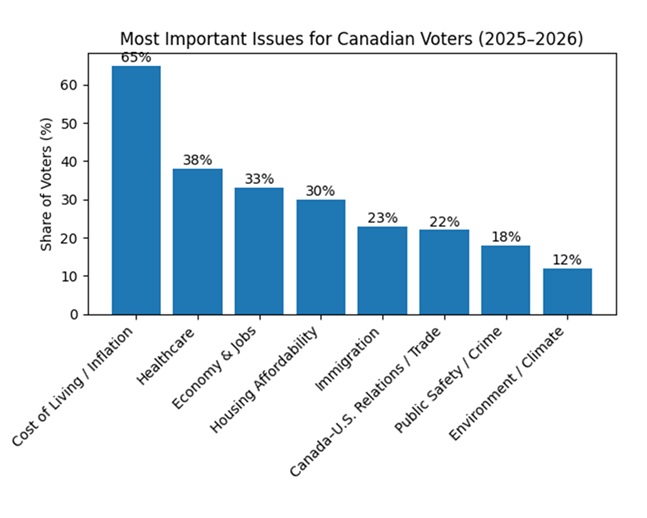
What Canadian Voters are Most Concerned With
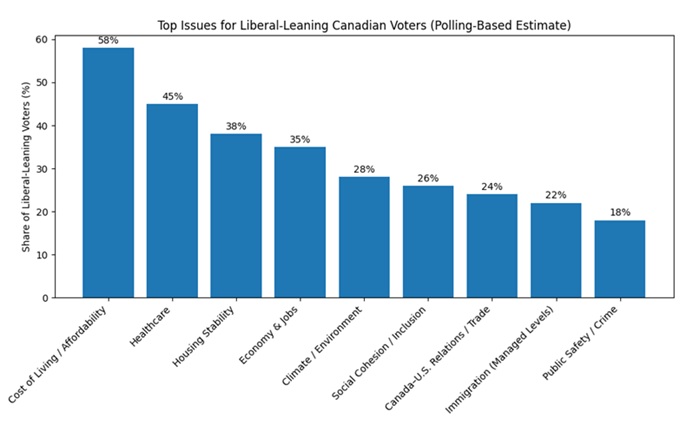
What Liberal Voters are Most Concerned With
This chart shows inflation is not as important to Liberal voters, although healthcare, climate, housing stability, and jobs are more important to them. Conservative politicians could change Liberal votes by showing how Liberal policies such as immigration have undermined the healthcare system and the economy.
What’s interesting though is Liberal voters loss of confidence in the Liberal Party itself. It’s hypocrisy of course, when they shift their belief in Mark Carney as the solution. This appears to be a voter group running out of places to hide. If nationalism isn’t the last refuge of a scoundrel, then the “Carney mania” surely is. The big media furor over the Epstein files has cooled as the media learned of Carney’s relationship with Epstein.
Where is Real Estate in All Of This?
What’s not asked is one issue that’s critical to know, because influential Liberals control it. And that is the propped up, real estate market with its over-valued properties, excessive rent prices, and shortages. It’s the source of immense suffering nationwide from the homeless to the working poor to those who may lose their homes, to young Canadians who feel real estate equity is essential to a safe, enduring life.
Governments pushed real estate into the role of Canada’s economic driver and store of wealth. It’s a dangerous path when the economy fails – because a housing market crash in Canada could happen. Many wealthy individuals want real estate values to stay high and rent prices too, so they can earn income, get tax breaks, and grow their wealth. Even if it hurts most Canadians appear to be firm in support of ensuring real estate prices don’t fall. BofC agrees.
And real estate is central to the stability of Canadian banks who are overextended in real estate. The BoC and the big banks are nervous about a potential housing market collapse which would expose them to big losses. A lower interest rate can help grow Canada’s economy, lower cost burdens, increase credit availability for small businesses. Yet even with inflation low, they have not dropped the central rate. That is significant.
Liberals: Spending, Immigration, Taxing, Privilege
Many Liberals (in my conversations with them) are okay about mass immigration. They make vague, general statements about “Canada needs immigration.” Their rationale might be due to so many baby boomers retiring, that more workers are needed to keep the social system afloat. They don’t even know what those young workers will do and whether AI will create massive unemployment — swelling demand on social programs in future.
But they don’t talk about the overspending by all levels of government and the consequences. That’s rolled over for the younger generations to face – a looming crisis for them to solve in the years ahead.
Normal reasoning tells us that if you overspend wildly and irresponsibly that no amount of immigration will balance the books. Liberal governments pull in immigrants to capture future voters and win elections. It’s worked well for them. They bloated government staff and infrastructure, sucked all the money out of the private sector, and gave it to privileged Liberals to fritter away on Woke-inspired non-sense, including regulations that have put our country at a severe competitive disadvantage.
Immigration: The Unacknowledged Source of Ultra-Inflated Real Estate Valuations
Immigration helps to prop up demand on real estate and rental prices, thus giving the wealthy and home owners the guarantees they look for. Some Conservative voters may actually like the “high home price” thing too, but they seem to be willing to let it go to bring Canada back again.
Big business too loves immigration, where they can pull in cheap foreign workers to keep wage demands down. They’re already paying workers in CAD for a 30% discount. They want more.
Foreign companies and big US corporations aren’t spending nor investing here. They do it all in the US, then use that advantage to compete unfairly in Canada – to put Canadian SMBs out of business.
Then the Federal liberals promise to spend more on big infrastructure projects to grease the rusty bearings. But the debt climbs fast without even a comment to be heard from the media or liberal voters. This is dishonest.
While the Liberal media is focused on trashing Alberta for threatening to withdraw the oil and gas revenues from freeloading Eastern Canada, it is a smoke screen hiding the troubling situation the Liberals have led Canada into.
Liberal voters obviously have a different set of values than Canadians, who are “being replaced” by a new ruling class of immigrants. They believe it will other people and not themselves who will face poverty and a loss of autonomy.
So why do Half of Canadians continue to Vote for the Liberal Party?
-
Risk Aversion & Loss Prevention (Status-Quo Psychology)
Core motivation: “I have something to lose.”
Many Liberal voters—especially homeowners, older voters, and established professionals—are motivated less by optimism than by fear of disruption and personal financial loss.
- They perceive the current system as flawed but predictable
- They worry that a change in government could:
- destabilize asset values (housing, pensions, investments)
- disrupt public services they rely on
- trigger market or policy shocks
- push Canada into a Conservative “cutback recession”
That’s not enthusiasm for the Liberal cause, it’s simply self-insurance voting.
In polling language, this shows up as “least risky choice,” “steady hand,” or “don’t rock the boat.”
-
Asset Protection (Especially Real Estate & Retirement Security)
Liberal Core motivation: “Don’t break the thing that holds my wealth and gives me more.”
For a large subset of Liberal voters:
- Their primary asset is housing
- Secondary assets: pensions, RRSPs, defined benefits, public-sector security
- They associate:
- immigration with demand support
- government spending with economic backstopping
- gradualism with price stability
Even if they verbally support affordability:
- They oppose policies that could sharply lower home prices or rent prices (landlord investors)
- They may fear anti-NIMBY zoning changes, market corrections, or aggressive reforms
This is especially true of:
- landlords
- multi-property owners
- seniors aging in place
- parents relying on home equity
-
Institutional Trust & Managerial Preference
Liberal Core motivation: “I trust systems more than business.”
Liberal voters disproportionately:
- trust federal institutions
- believe problems are best solved by experts, committees, programs
- prefer process over disruption
This includes:
- public-sector workers
- healthcare-reliant households
- credentialed professionals
- urban administrative classes
They are suspicious of:
- anti-institution rhetoric
- populist framing
- confrontational politics
Even when dissatisfied, they often conclude: “The system is slow and broken, but safer than tearing it down.”
-
Negative Partisanship (Voting Against Conservatives)
Liberal Core motivation: “I’m not voting FOR Liberals—I’m stopping Conservatives.”
This is one of the strongest but least admitted drivers.
Many Liberal voters believe the Conservative Party of Canada will:
- threaten social cohesion
- create the new cultural conflict
- pull easy social incomes and force people to work
- prioritize markets and profits over people
- reduce protections they value
- threaten the East’s priority in governing the country
This is amplified by:
- Liberal media framing
- U.S. political spillover
- memory of past Conservative governments
So even when they’re unhappy:
- Liberals feel like the “firewall”
- Conservatives feel like a gamble
This is defensive coalition behavior, not ideological loyalty.
-
Cultural & Identity Alignment (Urban, Multicultural, Federalist)
Core motivation: “This party reflects my socialist worldview.”
This matters more in Ontario and Quebec cities than elsewhere.
Key elements:
- pluralism
- immigration as a social good (even if levels are debated)
- discomfort with identity polarization
- in Quebec: federalism over sovereignty politics
This doesn’t mean voters are “ideological progressives.”
It means:
- they dislike cultural confrontation
- they prefer social continuity
- they associate Liberals with moderation
In an added twist with respect to Quebec separatists especially, Liberals often function as the anti-Bloc, non-sovereigntist default.
6. Incrementalism Bias (Fear of Big Fixes)
Core Liberal motivation: “Big solutions break things.”
Liberal voters may:
- accept that housing, healthcare, immigration are broken
- but distrust large, fast, structural fixes by the private sector
They prefer:
- pilot programs and research studies from consultants
- funding announcements
- gradual adjustments
- negotiated solutions with provinces/municipalities
This bias aligns with:
- older age
- higher net worth
- institutional embeddedness
They’d rather endure chronic dysfunction than risk acute disruption.
-
Media Networks & Information Environment Reinforcement
Core motivation: “This feels like the reasonable middle.”
Liberal voters tend to consume:
- mainstream, institutional media which has a strong Ontario/Quebec perspective
- Liberal expert-led commentary consistent with their perspective
- crisis-moderated narratives to show they’re level headed and in a position of authority
This environment:
- frames Liberals as pragmatic managers
- frames Conservatives as ideological or disruptive
- downplays asset-class conflicts
- emphasizes complexity over accountability
This doesn’t cause Liberal voting—but it reinforces it.
-
Poll-Level Ambivalence (Soft Support, Not Commitment)
Core motivation: “I’ll say Liberal—for now.”
This is crucial to your polling focus.
Many Liberal poll respondents are:
- undecided in practice
- weakly attached
- open to switching
- answering based on relative comfort, not conviction
That’s why:
- Liberal leads are often narrow
- support collapses quickly under pressure
- issue salience shifts matter enormously
They are not loyalists—they are conditional holders.
-
Anti-Western Resentment (Subtle but Real)
Core motivation: “The West is noisy, demanding, different, and greedy.”
Among some Ontario & Quebec Liberal voters:
- Western grievances are seen as:
- extractive
- populist
- overly confrontational
- unjustified
- Energy politics are framed as:
- irrelevant
- environmentally dangerous and uncaring about climate goals
- greedy and regionally self-interested
This doesn’t manifest as explicit hostility—but as dismissiveness.
The current matter of the Alberta separation or Wexit separation is seen as selfish and greedy – taking the ball with them and going home.
That emotional distance:
- reinforces Liberal identification
- hardens resistance to Conservative messaging
- fuels the “grown-ups vs. complainers” narrative
- Moral Licensing (“I’m a Good Person” Voting)
Core motivation: “My Liberal vote aligns with my socialist values—even if outcomes are messy.”
Some Liberal voters:
- separate intentions from outcomes
- feel morally aligned even when policy fails
- prioritize identity consistency over results
This explains tolerance for:
- housing failure
- affordability erosion
- homelessness contradictions
- hyprocrisy
This moral superiority self-image remains stubbornly intact even if material outcomes worsen.
There are key issues that aren’t mentioned, such as politics and wealth distribution.
Eastern politicians fear the rising political strength of the west and retaliation by Westerners. They also know the West pays a lot of bills in Canada. Alberta has paid $622 billion more in taxes into Canada (in the last 50 years) than it has received back. That’s an astounding number for a small province which has about 16% of the national population.
The direct battle of Ontario/Quebec with Alberta is just the face of this economic and cultural war.
Alberta wants its freedom to do business as it likes and raise their kids as they wish, without interference from Ottawa.
But the Liberals and their media empire have a lock on half of Canadian voters, enough to gain a majority rule — with more immigrant voters arriving daily. Given the party’s stubborn refusal to back down with the West, we can only conclude that the Alberta separation and a breakup of Canada is underway.
What Will Change Eastern Liberal Voter’s Minds?
What events/trends are most likely to affect eastern Liberals vote decision?
The Issue Most Likely to Break First:
Cost of Living → Housing → Immigration (in that order)
For eastern Liberal voters, personal economic security trumps everything. When the economy collapses, housing prices fall, and jobs dry up, the hard realities of life will appear before them.
#1 Liberal Vote Breaker: Cost of Living (Immediate, Personal)
Why it breaks first
- It hits everyone, including homeowners and seniors
- It undermines the Liberal “competent manager” brand
- It reframes every other issue as government failure
Trigger conditions
- Food, utilities, insurance, or property taxes rise faster than income
- Interest rates stay high or spike again
- New federal spending is seen as inflationary or wasteful
- Messaging shifts from “temporary pain” to “structural decline”
Vote shift mechanism
“They don’t have control anymore.”
This is when Liberal voters start looking, not just complaining.
#2 Liberal Vote Breaker: Housing Becomes a Threat, Not a Benefit
Why housing flips
Housing only breaks Liberal support when it stops feeling like protection and starts feeling like risk.
This is the critical inflection point for asset-holders.
Trigger conditions
- Property taxes rise sharply to fund homelessness or infrastructure
- Local crime, disorder, or encampments visibly affect neighbourhood quality
- Insurance premiums rise due to urban risk or climate exposure
- Children cannot afford to live anywhere nearby (emotional trigger)
Mechanism of the shift:
“My asset isn’t safe—and the Liberals don’t seem to care.”
At this point, voters become open to:
- zoning reform
- stricter enforcement
- population control arguments
#3 Liberal Vote Breaker: Immigration Tied Directly to Scarcity
Why immigration breaks later
Immigration is emotionally charged but is abstract — until it’s linked to scarcity and hits home close to them.
Trigger conditions
- Clear causal framing: immigration → housing shortage → service overload
- Healthcare access worsens in visible ways (ER closures, wait times)
- Schools, transit, or rentals feel overwhelmed by excessive volumes of migrants
- Messaging shifts from values to capacity limits and lower life quality they’re experiencing
Vote shift mechanism
“This isn’t compassionate anymore — it’s reckless and it’s affecting my life.”
This is when formerly “pro-immigration” Liberal voters pivot to:
- Immigration limits
- Geared to jobs and housing first
- enforcement rhetoric
Of course, the Liberal Party knows all about this and is aggressive in shielding Liberal voters from the truth about housing and food inflation, rising taxes, and degradation of Canadian values. That’s what their media outlets are for.
More Wishful Thinking About a Conservative Election Win?
Of course, a long bet is that the Conservatives will win an upcoming lack of confidence vote the Liberals, form the new government and the West’s problem would suddenly evaporate. Not so fast. We’ve had Conservative governments before and Alberta voters might decide it’s time to move on from any Ottawa connection. It’s not the party, it’s the place.
A clean slate, when presented to Albertans will garner a lot of attention – making Ottawa the scapegoat for cleansing everything in their lives. Ottawa has few friends in Alberta, with only 2 Liberal seats held in Calgary Skyview (high east indian population) and Edmonton Centre (large, transient youth population).
You must have some thoughts on the West-East battle, and where the country is headed. Give me your outlook for Canada’s economy, housing market, and job growth. Do you feel secure about the next 10 years as the Liberals veer Canada away from the US in trade? How successful will non-US trade be? Isn’t this the most risky decision Canadians can face?
Title image courtesy of Reuters