
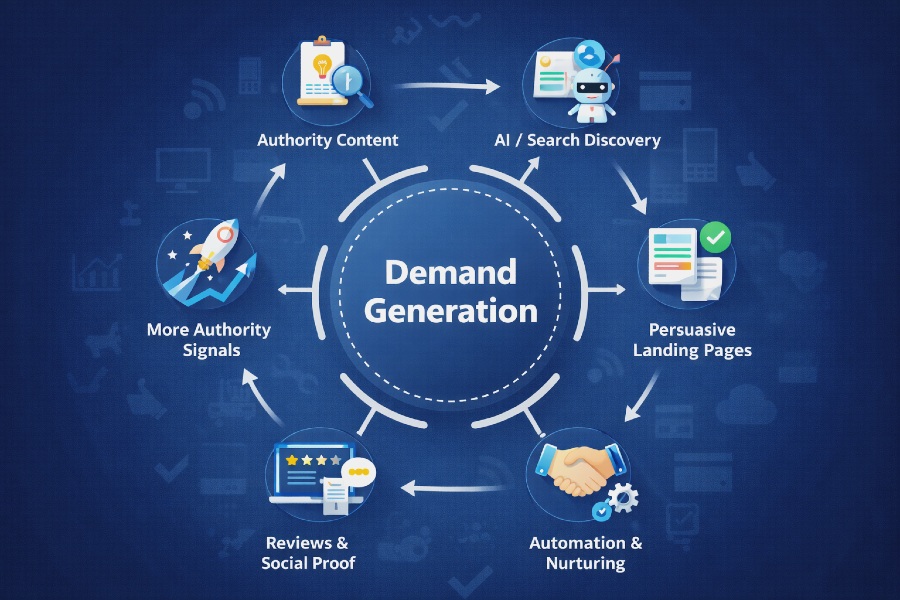
Create your Company’s Demand Generation Engine
If you’re waiting and hoping your website will deliver high intent, willing, paying customers and on a reliable basis, you should uncross your fingers. A better approach is convert your website and social pages into demand generators.
Aside from developing a demand generation strategy and using AI platforms, your new approach is build lasting, owned assets as your private platform to stay visible, capture customer relationships and then carry visitors to a purchase.
The problem with leaving your website as a branding brochure, info source, or a travel magazine, is that it isn’t powerful enough to generate leads and it won’t convert leads as well.
Use Agentic AI to Make This Much Easier
New marketing platforms are designed to take the user as far as they can go in a purchase, smoothing out the discovery to purchase process, removing all friction, to capture more user intent — to generate more demand for products/services/subscriptions etc. Of course, AI is at the center of it, removing the grinding hard work and guesswork everyone’s been doing for so long.
Expertise and a good system (Agentic AI) help you escalate your marketing to become a demand engine. And we can spend more time in strategy and making the right decisions.
Oh yes, new AI powered systems are really into demand generation – and keeping all of it. And their systems can increase engagement, improve responsiveness, ease their uncertainty, make them feel in control, and in many cases (e.g., travel planning and bookings) execute purchases (e.g., trip bookings). What we’re talking about isn’t the old “marketing flywheel” concept but rather a new capacity called the demand engine.
You’ll likely be adopting or progressing gradually to fully automated Agentic AI platforms. However, the best of what you and your advisors and creators do will still be needed — you’ll just reach more prospects. And your lead conversion process will be executed through an 8 stage lead generation process on your website.
With AI automation, your website (and social pages) work 24×7, greeting all types of visitors no matter what their interest or buying phase they’re in. It works to harvest the visitors intent and turn it into demand for your product/service.
What is a Demand Engine Website?
A demand-engine website is designed to actively attract, educate, persuade, and convert potential customers rather than simply presenting information about a business. It uses strategic content, search and AI discoverability, persuasive messaging, and clear conversion paths to turn online visitors into inquiries and sales opportunities. Instead of waiting for people who already know your company to visit your website, a demand engine continuously brings in new prospects through search engines, AI recommendations, and shareable expertise, answers their questions, builds trust with proof and guidance, and invites them to take the next step. For a business owner, it transforms their website from a passive digital brochure into a 24-hour marketing and lead-generation system that steadily creates awareness, inquiries, and revenue.
The 3 most important factors in a demand-engine website are:
- high-visibility authority content that gets discovered in search and AI answers.
- persuasive page architecture that builds trust and guides decisions.
- clear conversion systems that capture and nurture leads into customers.
AI is Forcing Us to Take Control of Demand Generation
Providing information isn’t the goal anymore in B2B or B2C. Engagement, trust, guidance and friction-free forward action are the priorities. Demand generation leverages all of that to capture the greatest amount of customer intent to generate a new customer.
It’s a fact that we must be more strategic and assertive about protecting our connection with our target market. Our connectivity and sales are at stake unless we build our own demand generation assets.
Is AI Your Friend or Foe? You Get to Decide
Whether you’re in real estate, professional services, or in the travel business, it’s all the same. As Andrew Yang comments on frequently on CBNC, a lot of investment is being funneled into AI data centers, processing and infrastructure, and a coming revolutionary growth in AI capabilities is near. For AI-marketing enabled companies, this offers an opportunity to be more competitive, efficient and resonant with the big AI LLMs. I think you might like the idea of leveraging this fantastic technology to create and capture the higher quality travel customers using them.
Andrew points out this tremendous AI growth. It suggests strongly that new business models and staffing structures will proliferate. All of them will focus on taking control of this opportunity, instead of letting it wipe out their companies.
Yes, It’s Content, but Much More
Content is what visitors want and what helps capture them, engage them and convert them to customers. Unfortunately, your old, traditional style content could be disregarded completely by ChatGPT, Perplexity, Copilot and Gemini. That means the discovery layer of web visibility is wiped out. You’ll need to create a fresh new layer of lead generating, engaging and converting content (see GEO post) designed and optimized for how these AI engines think, and what they value.
As you’ll read here, the activation of AI marketing opens up more than just fresh, AI-optimized content. The big picture benefits extend beyond the easy to see details.
We have to face the fact that AI is taking over publishing at the information level. That passive content isn’t generating visibility or leads anymore. For content beyond the topic discovery phase, we have to strategize to dominate visibility and leads that may come through the AI search engines. These leads are deeper into the travel buying journey, and some experts say these leads convert at a higher rate.
Even leads through social and other sources will be highly processed by AI. There’s no escaping it now.
You’ll still have your information articles/posts of course, because customers do want to hear these messages from you personally in your voice. They love you and your brand and you’ll want to keep that nice conversation going. It’ll help your AI search engine visibility too (GEO).
You’ll Own Your Demand Generation Machine
What you’ll see here, is that your next engagement and lead generation platform will also be owned by you and can be AI-monopoly resistant, while still getting what you can from Gemini, ChatGPT, Perplexity, CoPilot, Claude and all the rest. Unfortunately, these AI companies are looking to take all the value out for themselves. We need to act to get our cut of the action.
For a business to transform its website into an active demand-generation engine, the shift is not just about adding more content or ads. It requires re-strategizing and redesigning the entire marketing architecture around visibility, persuasion, conversion, and continuous engagement.
7 Key Aspects of a Demand Generation System
-
AI-Discoverable Content Architecture (SEO + GEO + AEO)
Traditional websites https://gordcollins.com/web-design/your-website-is-your-business/ are written for human browsing and Google rankings. The modern demand engine we’ll create must also be designed for AI discovery, summarization, and recommendation.
Assets that must change or be added
- Entity-based content structure (resources, people, events, and anything that appears in the knowledge graph
- Topic cluster / pillar architecture – fuller, authoritative coverage of topics and customer questions
- AI answer blocks and summaries – easier for AI systems to comprehend and spider
- Conversational question pages – human-friendly discussions off issues/topics
- Comparison pages – letting AI systems understand how your offering compares to competitors
- Use-case pages – practical demonstrations (grounding) of why your offering is needed
- Structured product/service explanation pages – data formats that are AI-friendly
Key practices
- Create clear factual explanations AI can quote
- Use FAQ schema and structured data
- Include definitions and summaries
- Add “why choose us” evidence sections
- Publish comparison content (AI engines use this heavily)
AI Search Factors
AI engines prioritize content that is:
- Structured
- Authoritative
- Quotable
- Clear
- Contextual
Example formats AI favors:
- FAQs
- Bullet summaries
- Step-by-step guides
- Lists
- Expert explanations
These become training material for AI answers.
-
Persuasive Conversion Architecture
Passive websites assume visitors will figure things out themselves. Demand engines guide visitors through psychological decision stages.
Assets required
Trust Builders
- Customer reviews
- Testimonials
- Case studies
- Expert credentials
- Media mentions
- Certifications
Conversion Pages
- Landing pages
- Service pages designed for conversion
- Comparison pages
- Buyer guides
- Pricing explanations
Decision Support Tools
- Quizzes
- Trip planners
- Cost calculators
- Assessment tools
- Interactive comparison charts
Key practices
- Every page should answer why the visitor/customer should act right now:
- Use:
- social proof
- risk reversal
- authority signals
- clarity of outcomes
Lead Capture Infrastructure
Passive sites rely on contact pages. Demand engines create multiple capture opportunities across the site via many diverse content pieces (but always focused to leverage your most profitable assets).
Lead capture assets
- Lead magnets
- Newsletter signup
- Downloadable guides
- Webinar registrations
- Travel planning consultations
- Free assessments
- Email mini-courses
Best practices?
Use progressive engagement:
- Light commitment
- Medium commitment
- High commitment
Example funnel:
Visitor → Guide download → Email nurture → Consultation → Sale
-
Marketing Automation & AI Engagement Systems
A demand engine continues the conversation after the visitor leaves your website. Your Agentic AI marketing platform makes this level of content and ongoing engagement possible. It determines best times, what to say, and what they need to see next.
Key infrastructure elements
- CRM system
- Email automation
- AI chatbots
- Messenger or SMS automation
- Retargeting campaigns
- Behavioral triggers
Assets required
- Email nurture sequences
- Follow-up campaigns
- Event triggers
- abandoned inquiry follow-ups
- segmented campaigns
Example triggers:
- Viewed pricing page
- Downloaded guide
- Returned visitor
- Booked consultation
This is where Agentic AI marketing platforms come into play and make the impossible doable.
-
Traffic Acquisition & Visibility Engine
Passive sites wait for traffic. Demand engines actively distribute content and attract audiences and coordinate across channels.
Core traffic channels
Search
- SEO
- GEO (Generative Engine Optimization)
AI discovery
- AI answer inclusion
- knowledge panels
- entity authority building
Social
- short video
- expert commentary
- community engagement
Paid channels
- Google Ads
- Meta Ads
- YouTube Ads
Referral sources
- partnerships
- affiliates
- media features
- directories
AI Search factors
AI systems use multi-source evidence for more certain, validated search results and responses.
Signals include:
- citations from multiple sites
- brand mentions
- reviews
- social discussions
- structured knowledge pages
This means brand authority across the web matters more than ever.
-
Content Authority & Trust Ecosystem
AI search engines increasingly evaluate entity credibility across the web. Demand engines help build distributed authority signals.
Assets
- Wikipedia or knowledge graph references
- industry directory listings
- expert interviews
- podcast appearances
- guest articles
- citations in media
- partnerships
Best Practices
Create authoritative digital footprint:
- expert commentary strategically and tactically published
- thought leadership aligned with topics
- original research and data the AI engine can reference
- data reports that make it easier for the AI engine to comprehend and parse
AI engines trust recognized experts and sources.
-
Analytics, Feedback & Continuous Optimization
Demand engines constantly improve on their performance, and quickly when you’re using an Agentic AI system.
Assets
- marketing dashboards
- funnel analytics
- attribution tracking
- user journey analysis
- conversion heatmaps
Metrics that matter
- visitor intent signals
- lead quality
- conversion rate
- cost per lead
- revenue per visitor
AI tools can now automatically detect:
- weak content
- funnel drop-offs
- audience segments
The demand engine concept works well with your Agentic Ai marketing platform given they were designed with demand generation in mind.
In the next post, I’ll dive into what your demand generating content should look like.
Interested in trying out a pilot project in your marketing program? You can try out an Agentic AI platform, try a new content strategy, optimize one of the lead gen stages, develop a new SEO/GEO strategy and test new creative content ideas and formats.
Let’s chat and explore how I can work with you to help you thrive in this challenging era.