
Generative Engine Optimization: A Practical Guide for Small Business Owners
More customers are now getting answers, recommendations, and buying guidance directly from AI systems like ChatGPT, Gemini, and Copilot—often without ever clicking a website.
For many small business owners, this shift shows up quietly in fewer search engine referrals, less inquiries, and more hesitation from prospects who seem interested but never convert. Web visitor stats don’t quite reveal what changes AI engines are creating in the organic visibility and leads space. But the shift to AI engines and GEO is on, even if Google keeps its massive search dominance.
Generative Engine Optimization (GEO) is the practice of shaping how AI systems interpret, summarize, and recommend your business at the moment customers are forming decisions—before they ever reach your website. GEO is the new type of SEO-strategization, well-conceived and expertly implemented to meet your need for visibility in increasingly used and powerful AI search engines.
Creating the Content AI Engines Want
Before a customer reaches your site, AI engines are already summarizing who you are, what you offer, and whether your content is worth considering. If your business isn’t clearly understood and confidently represented inside those AI-generated answers, you may be losing customers before you ever get a chance to persuade them.
If your content is very relevant, GEO-organized and trusted, the AI engine could provide quite a nice recommendation in its response to users, and often with few other competitors mentioned. The key point here, is that these engines actually read your content and they may not agree with what it says — classifying it as inaccurate, unsubstantiated and low quality (hurting the pride of many travel writers).
Unfortunately, your old copy style, casual and engaging may not work well at all with AI search engines. They’re looking for something drier, more organized and easier to extract info from, to help them answer questions.
GEO, what we’re discussing here is just one part of a search engine optimization strategy. It shouldn’t be done in isolation. One nice thing is that a sophisticated SEO/keyword optimization will help establish relevance to AI engines. Keywords are a big part of consumers query language and an important signal to an AI engine.
Examples of GEO Content
I’ve created 3 articles optimized for GEO for you to review:
- How to Make Your Brand Powerful in Search
-
How to Guarantee You’ll Win the Battle of Top Sporting Goods Brands
They’re comprehensive, organized and written in compliance with GEO principles, structured to answer questions, and more.
GEO Techniques to the Rescue
This guide explains what’s involved in Generative Engine Optimization (GEO) and how we can use it to maximize visibility in AI search engines.
GEO and SEO are different practices given each engine has its own specific goals, processes and values. With GEO, content presented is drier, more organized/classified, and structured, almost like a library version where meanings are easy and fast to extract. Persuasive, creative, enriched copy (as travel writers specialize in), may be considered fluffy, confused, and low quality to the AI engine.
It’s facts vs emotion. However, there are techniques I can include both in your site and pages to satisfy GEO engine demands, while still being creative and human enjoyable. In the end it’s the visitors emotional satisfaction that drives your revenue.
Key strategies for GEO include:
- Structuring text content for Precise, Clear Answers: answering searcher’s questions in a specific, clear, concise language in a layout format (e.g., bullet points, tables, FAQs) that’s
- Building Topical Authority: Creating comprehensive, in-depth content clusters that cover a subject thoroughly to establish expertise.
- Entity Optimization: Using specific, consistent terminology to help AI identify key people, places, or concepts.
- Citations and Credibility: Including authoritative sources, statistics, and expert quotes to increase trust signals.
- Complementing SEO: GEO relies on strong foundational SEO, as many AI-cited sources also rank in the top 10 of traditional search results (Gemini uses the Google search database).
- Grounding: refers to the creation of highly structured, authoritative, fact-rich pages that an AI system can confidently reference to support its generated response. Grounding is used when an AI system must search the web in real time to find clear, reliable source pages to reference.
What’s Driving this GEO Explosion?
Quality, productivity, deeper insights, breadth of instantaneous research are driving usage. Well, that and laziness. Yet, workers and consumers are time-pressured and tired. Exhausted creators tend to churn out mediocre content and content that doesn’t resonate with these AI systems.
Regardless of your customers state of mind however, AI engines are raising the quality of information and perhaps improving users comprehension of the value you provide.
With expectations of greater productivity, you, your staff, and outsourced talent will have to kick it up a notch — and this is how it’s done now. For content marketers specifically, AI can provide a significant lift.
It’s raising your ability to stay competitive in scale, quality, performance and results.
What’s Happening Now
AI engines serve up information/answers lightning fast, which were being provided on company’s websites . They’re swiping that info, processing it and serving it up in their own answers and overviews. And as these charts show, users prefer to have AI engines version.


So, for a travel question such as “Where are the best vacation spots in Mexico“, users get a well-defined, structured answer, as opposed to a list of top ranked Mexico travel webpages.
The AI engines are here and users are using them to make home repairs, find best houses to buy, research and choose their favorite travel destinations, and even get health and medical advice. They’re liking what they’re finding. Not being found in the AI search results/chat sessions is a concern for any small business owner. The future is arriving.
GEO does not cancel SEO which you might know still generates most web traffic. This is a new facet of visibility in search, and one that every real estate company, travel company and SaaS software company needs to master.
Another Reason to Build and Optimize Content Intelligently
The pain for your real estate, SaaS, or travel business is invisibility and zero leads. It’s also about having your business brand/service misinterpreted by these AI engines — made irrelevant on AI principles and skewed information. GEO helps to reconfigure the view of your company and online content, positioning it ideally for visibility.
GEO helps us fashion your content so it’s more relevant to how AI search engines read and process what they collect from your website.
GEO focuses on making content so clear and authoritative that an AI search engine chooses to synthesize information from it or cite it as a credible info source within a direct answer to their users. That site or company then becomes visible to the searcher and it may result in them clicking through to their website to dig down further into their own website content.
In this guide to optimizing content for Generative AI search engines, we find a powerful way of winning the new search engine wars.
GEO is a new technique that can help us create:
- improved content clarity and coherence
- Improved content structure (for GEO/SEO)
- greater voice of authority, trust and credibility
- Increased visibility (and clicks) in fast-growing AI search engines
- increase the connection between your brand and the best topics
What GEO Means to Your Business
In our SEO/GEO audit/opportunity review, we unearth your prospect’s interests, goals and the questions they are asking AI search engines.
GEO means we have to be more mindful of the topic itself and what questions users are asking and whether your content is part of the answer AI search engines will give to users. This is not as organic as it is with Google’s algorithm, and instead it’s more technical-based on the constructs the AI engine has been programmed to reference. This is why GEO pros are focusing on what’s called structured data, which categorizes and connects data. This library science of GEO defines hundreds of content “types,” such as Product, Article, and Event, and the “properties” that describe them. You can rely on me to understand the technical elements and how to weave this into creative copywriting, that will also impact, engage and persuade.
It’s Personalization in a Science Kind of Way
Generative engine optimization focuses on the topic itself and how its training model understands a topic (e.g., best vacations in the USA). However, LLMs increasingly integrate user experience signals (clarity, readability, engagement) and these are elements that lend themselves to clever optimization. Clever is the word that’s missing today, because most marketers are struggling with understanding SEO and GEO principles. They’re using them in a basic, beginner way
However, AI search engines have already progressed to dig deeper for unique, engaging, and more extensive content experiences. They improve and change constantly, and trying to get a handle on real human conversation and what humans feel as they interact.
For the question asked in the graphic below, “where is the best place live right now in the USA?” ChatGPT’s response balks because it wants more context, because its training model has programmed it to be more helpful and specific based on individual perspectives. Still, it offers up a few destinations (articles) that might fit the bill.
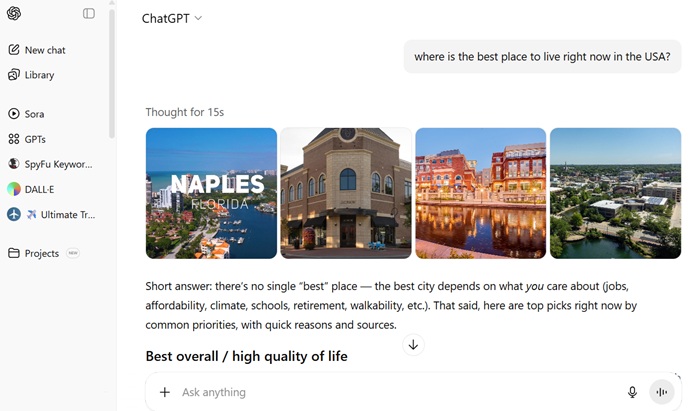
Generative engines respond to users with their own questions to better understand what they’re looking for. Google and Bing don’t do that. The engines try to understand the context of a user’s inquiry (e.g., where is the best place to live right now in the USA?). The context is most livable cities, neighborhoods, and what the search user wants in a new city/neighborhood. Your content needs to be organized, clarified so the engines can quickly and easily extract snippets and paragraphs.
GEO means understanding what ChatGPT/Gemini are looking for, ensuing that is infused into your content.
Our content goals: Clarity, structure, and authority — translated for AI systems.
With respect to many areas of business or publishing, it’s important to remember that AI engines (ChatGPT, Gemini, Perplexity, Copilot) don’t reward metaphor, implication, or emotional buildup the way humans do. They reward:
-
Structured clarity
-
Declarative insights
-
Named frameworks
-
Data anchoring
-
Clean segmentation
-
Extractable summaries
Our content must be entertaining and persuasive, yet also AI-extractable.
Our GEO Quest – Our AI Optimization Framework
Our GEO quest is to:
- create an optimization model framework
- have your content considered as part of an important conceptual topic/context that AI LLM engines are focused on
- associate your brand with your key topics
- making your content the most respected resource — aligned with the engine’s evaluation process
Our quest is to research and creatively design our content in a relevant, trustworthy, credible fashion so the AI LLM believes it is important to the conversation. We need to build in the right entities, connecting them with the best topics/ideas/solutions/stories/data, demonstrating topical authority, and then like a spider web, prove semantic proximity to important industry terms, concepts, and authoritative entities. Sorry about the technical lingo.
AI Powered SaaS SEO software company SemRush investigated which brands/content appeared in AI Chatbot searches. They found that content pieces that appeared in AI engine searches had these characteristics:
- Clarity and summarization (33%)
- E-E-A-T signals (30%)
- Q&A format (25%)
- Section structure (22.91%)
- Structured data score (21.60%)
Creating Better, More Credible and Useful Content for Prospects
Reading or engaging in your content is considered an experience. We want that to be enjoyable and valuable.
Some refer to GEO as generative experience optimization (GXO). At a higher level, this means creating content that provides a credible, authoritative, informative and helpful user experience so that AI LLMs will refer to it or cite it in its responses to users. The “experience” then is the overall quality of engagement for the user. So we’re optimizing the end product for users for better engagement and results, rather than just matching the AI LLMs algorithm.
With a more comprehensive and enjoyable experience, our content is better validated and it may produce a larger number of citations in searches and new customer leads.
The AI LLM Friendly Creation Process
We create our AI engine friendly content via research as usual and creatively produce some engaging and accurate/relevant content pieces (blogs, guides, new releases, charts with data, surveys, and product pages).
Appearing trustworthy and authoritative isn’t easy. This is where promotion in industry magazines, and reaching influencers can be helpful. Through promotional campaigns, we look to create brand mentions (especially in semantically rich and authoritative contexts) are now just as critical. Think of this as semantic reputation. If AI sees you and your brand cited consistently alongside top concepts and credible voices, it deems you trustworthy.
Thought leadership means producing thought leadership, engaging with industry leaders, connecting with them on social media and getting their views on your content. It’s how you get associated with these topics/ideas/concepts that AI search engines respect.
In essence, your new GEO content gets your brand/website/content included into that sphere of highly trusted and significant entities (people, companies, topics, keywords, thoughts, concepts etc.).
GEO Content Optimization Guide: 10 Steps to Visibility in Generative Engines
This 10 step guide gives us an actionable plan to design and implement content specifically for ChatGPT, Google Gemini etc. that will fulfill all of their demands.
Step 1. Define the Core User Questions
- Action: Identify what users actually ask in conversational form, not just keywords. Provide clear, direct answers and reference relevant entities to those topics.
- Travel Example: Instead of “Best Italy tours,” list questions like: “What’s the best Italy tour for food lovers in 2025?” or “How much does a guided Tuscany trip cost?”
- Realtor Example: Instead of “Toronto condos,” target “Is now a good time to buy a condo in Toronto?”
Step 2. Build Context-Rich Pages
- Action: Write content that fully answers those questions with background, explanation, and supporting details. Generative engines reward “completeness.” Don’t just give answers—show cause, effect, comparisons, and examples, using explanations, scenarios, and perspectives.
- Travel Example: A page on “Best Italy tours for food lovers” should cover regional cuisines, tour lengths, costs, and sample itineraries.
- Realtor Example: A blog titled “Should I wait to buy in Toronto’s condo market?” should explain mortgage trends, supply data, and affordability.
Step 3. Use Conversational Structure
- Action: Write in natural Q&A form. Break content into user-style questions and answers.
- Travel Example: FAQ like: “What’s included in an Italy food tour?” “Is airfare covered?”
- Realtor Example: “What’s the minimum downpayment in Ontario in 2025?”
Step 4. Strengthen Topical Authority
- Action: Build clusters of related content that interlink naturally. Generative engines recognize “topic depth.” Build clusters of content around a core pillar (e.g., “Toronto real estate market guide 2025” + subtopics: mortgages, neighborhoods, taxes).
- Travel Example: A travel site with guides for Italy food tours, Tuscany wine tours, and cooking classes → cluster around “Italian Culinary Travel.”
- Realtor Example: Cluster pages: “Toronto condo market 2025,” “GTA mortgage rules,” “Best neighborhoods for young buyers.”
Step 5. Add Local & Temporal Signals
- Action: Include location details and dates/timeliness so content doesn’t feel generic. Utilize entities such as local restaurants, tourist venues, farms, transit, cultural events, to build context.
- Travel Example: Mention “2025 Italy tour prices may rise with inflation” or “Florence’s 2025 food festival.”
- Realtor Example: Use local MLS stats or “Toronto condo inventory has dropped 12% in 2025.”
Step 6. Provide Evidence & Sources
- Action: Cite stats, local news, or expert authority sources. Generative engines often summarize content with citations.
- Travel Example: Reference travel market stats or a TripAdvisor traveler survey.
- Realtor Example: Quote NAR or CAR housing reports or MLS housing stats.
Step 7. Optimize for Readability
- Action: Use short sections, bulleted points, and tables for easy summarization by generative engines.
- Travel Example: Quick comparison table of “3 Tuscany Food Tours – Cost, Length, Highlights.”
- Realtor Example: Table showing “Condo Prices vs. Rent Costs in 2023–2025.”
Step 8. Incorporate Human Perspective
- Action: Engines prefer content with a unique, human voice or lived experience.
- Travel Example: Add a short first-person story like: “On our Tuscany food tour, we cooked with a Michelin chef in Florence.”
- Realtor Example: Case study: “A young couple bought a condo in Mississauga with 5% down – here’s how.”
Step 9. Encourage Engagement
- Action: Add calls-to-action, checklists, or interactive elements so content is “active,” not static.
- Travel Example: Checklist: “What to Pack for a 7-Day Tuscany Tour.”
- Realtor Example: Interactive affordability calculator embedded on a blog.
Step 10. Continuously Refresh & Expand
- Action: Update content every few months to keep it fresh; generative engines prefer recent, evolving content that’s connected to the questions your users are concerned about this year.
- Travel Example: Update with “New Italy tours launched for 2026.”
- Realtor Example: Update with latest Toronto condo price charts.
Grounding Pages: Key Pillar Content for AI Engines
Just a note on grounding pages, which should be your key AI-engine facing pages that are referenced most by AI engines. These pages will take more of your research, writing/editing and strategic planning, just as we created previously via SEO for Google. Your grounded pages can be:
- Pillar content theme pages — key topics and user questions
- Definition pages — defining for the what, where, when, why and how
- Research-backed authority articles — respected sources that cite/back your information/claims
- Comparison guides — helping users find the right choice for them
- Industry breakdowns — macro factors that impact solutions/service/product choices
- Trend info — AI engines prioritize trend language.
Grounding pages answer:
- What is…
- How does…
- Why does…
- Trends in…
- Costs of…
- Pros and cons of…
And these pages should be:
✔ Structured
✔ Clear
✔ Specific
✔ Neutral in tone
✔ Fact-rich
✔ Organized
These grounding pages are the structural authority backbone of your website. They’re likely to drive most of your visibility and referrals, but also determine how the AI system values your content for users. They’re a key part of your GEO strategy and we need take time to construct them professionally.
That’s a simple 10-step action plan for an AI search engine optimization strategy makes your real estate agency or travel business website significant to AI LLMS like ChatGPT or Google Gemini.
GEO is an exciting new practice, definitely an advanced form of SEO, and one that’s going to keep you ahead of your competitors. When you hire a SEO/GEO Content strategist you’re giving yourself an enhanced shot at success in a crowded marketplace. Let’s kick it up a notch and win!
If you’re interested in advanced SEO/GEO services, please contact me, Gord at 416 998 6246.
GEO FAQs
1) What is Generative Engine Optimization (GEO) and how is it different from SEO?
Traditional SEO helps you rank in search results. GEO helps you become part of the answer itself. Instead of optimizing only for clicks, GEO optimizes for AI understanding, citation, and recommendation at the exact moment a customer is making a decision.
2) Why are my website visits and inquiries dropping even though my rankings haven’t changed?
AI tools are increasingly answering customer questions without sending them to websites.
Your content may still rank in Google, but if AI systems:
- can’t extract clear answers from it
- don’t trust it
- don’t see topical authority
your business becomes invisible earlier in the decision journey.
That’s a GEO visibility problem, not a traditional SEO problem.
3) How do AI systems decide which businesses to mention in their answers?
They look for content that is:
- clearly structured
- fact-supported
- topically comprehensive
- consistent in terminology
- semantically connected to trusted entities
They are not “ranking pages.” They are selecting reliable knowledge sources.
4) Do I still need SEO if I invest in GEO?
Yes. Strong SEO:
- builds relevance
- earns links and mentions
- creates the authority signals AI systems rely on
Most AI-cited sources already rank on page one in traditional search. SEO builds authority → GEO converts that authority into AI visibility.
5) What types of content are most likely to be cited by AI engines?
Your article already hints at the winners. The most citable formats are:
- definition pages
- research-backed guides
- comparison pages
- cost breakdowns
- industry trend analysis
- structured FAQs
These become your grounding pages.
6) What are grounding pages and why are they critical for GEO?
Grounding pages are your most structured, factual, comprehensive, and authoritative content assets.
AI systems use them as reference points when generating answers.
They define:
- how your brand is understood
- what topics you are trusted for
- whether you get cited
7) Can creative, emotional, or storytelling content still work in a GEO strategy?
Yes — but it needs a structured foundation.
The winning model is AI-extractable clarity + human persuasion. This means it must have clear answers for the AI and an engaging experience for the human user.
8) How long does it take to see results from GEO?
You can see early signals when:
- your content starts appearing in AI answers
- branded AI queries improve
- assisted conversions increase
But the real impact comes from building:
- topical authority
- semantic reputation
- trusted grounding pages
This is a compounding visibility strategy, not a quick ranking tactic.
9) How do I know what questions my customers are asking AI tools?
Through:
- conversational query research
- sales call mining
- customer email analysis
- AI prompt simulations
- Search Console + on-site search data
GEO starts with real decision questions, not keywords alone.
10) What is “topical authority” in a GEO context?
It means your site:
- covers a subject completely
- connects related concepts
- links structured content together
- demonstrates expertise from multiple angles
When this happens, AI systems treat your brand as a trusted source for that topic — not just a page.
11) Is GEO only for large companies?
No — this is actually where small businesses can win.
Why?
AI systems don’t reward brand size. They reward:
- clarity
- depth
- expertise
- relevance
A well-structured small business site can outperform a large, unfocused one.
12) What are the biggest GEO mistakes small businesses make?
- Writing only for humans, not for extractability
- Publishing shallow blog content
- Ignoring entity consistency
- Having no topical clusters
- Failing to update content
- Lacking data or citations
13) How does GEO generate leads if users don’t always click?
AI visibility creates:
- brand pre-qualification
- trust before the visit
- higher-intent visitors
- shorter sales cycles
When they do click — they already believe you’re the expert.
14) How often should GEO content be updated?
Continuously.
AI systems prefer:
- fresh data
- current context
- evolving content
A quarterly refresh cycle is a strong starting point.
15) What does a GEO strategy look like for a real estate, travel, or SaaS company?
It typically includes:
- Core question research
- Grounding page development
- Topical content clusters
- Structured data implementation
- Authority and citation building
- Ongoing content refresh
15. Is GEO the same as Answer Engine Optimization or AEO?
No — GEO is broader than AEO.
Answer Engine Optimization (AEO) focuses specifically on structuring content so it can be extracted as a direct answer in AI responses, featured snippets, and voice search.
Generative Engine Optimization (GEO) includes that, but goes much further — it’s about making your brand and content discoverable, trusted, and recommended by AI across the entire customer journey, from initial research to final purchase.
Title image courtesy of Stockcake.