Will the Price of Oil and Rising Rates End the Long Bull Rally?
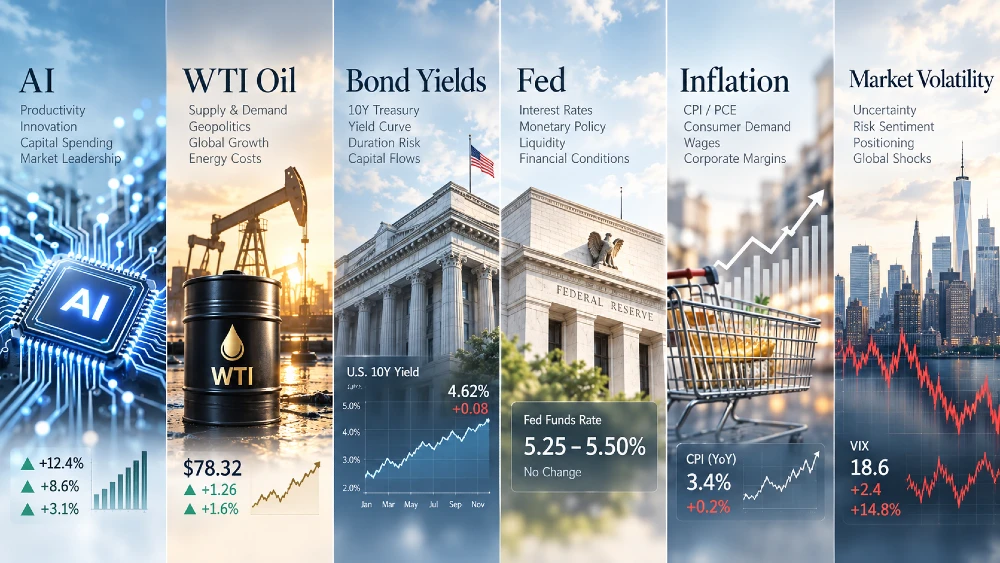
Oil, US inflation, the Fed, Bond/Treasury yields and the AI investment boom have suddenly become one interconnected problem for investors.
For much of the past several years, investors could separate and understand the major forces affecting the stock market. It’s is so complex now, that everyone is getting confused and don’t know which signals to follow. That confusion is amplified by common investor beliefs such as “markets crash when oil prices soar.”
What’s happening now in late 2026, is these market signals/metrics are becoming aligned as one overall signal. And perhaps the market is more AI driven now, and this is how AI systems are viewing it.
By late September 2026, the U.S. stock market is facing an unusual combination of pressures: oil remains expensive because of continuing instability in the Middle East, inflation is proving persistent, the Federal Reserve has resumed raising interest rates, long-term Treasury yields have moved above 5%, and enormous amounts of capital continue to flow into artificial intelligence infrastructure.
Yet U.S. equities remain remarkably resilient.
On September 25, the benchmark 10-year Treasury yield briefly reached 5.23%—its highest level since 2007—while the 30-year yield climbed above 5.5%, its highest since 2004. At the same time, major U.S. stock indexes were still advancing modestly, supported partly by renewed enthusiasm for artificial intelligence.
That divergence raises one of the most important questions investors face heading toward 2027:
Can the stock market continue rising in a world of $90 oil, 5% Treasury yields and higher interest rates?
The answer increasingly depends on whether corporate earnings, particularly those associated with the AI investment boom can grow fast enough to compensate investors for a much more expensive financial environment.
Oil Is No Longer Just an Energy Story
The first issue retail investors need to recognize is that oil now matters far beyond energy stocks.
The continuing conflict involving Iran and disruption surrounding the Strait of Hormuz have kept a geopolitical premium embedded in crude prices. Before the war, the Strait was one of the world’s most important energy transit routes. Shipping remains far below normal levels, although diplomatic discussions have raised hopes that traffic could eventually normalize.
That uncertainty matters because sustained high oil prices move through the economy first through producer prices, but now they might be starting to hit consumers harder.
Higher crude prices increase the cost of gasoline, diesel fuel, aviation, freight, chemicals, manufacturing and many forms of transportation. Businesses then face a choice: accept lower margins or pass those costs on to customers.
That is how an energy shock becomes an inflation problem and then becomes an interest-rate problem.
The transmission mechanism increasingly looks like this:
Middle East instability → higher oil prices → higher business and consumer costs → persistent inflation → tighter Federal Reserve policy → higher Treasury yields → higher borrowing costs and lower tolerance for expensive stock valuations.
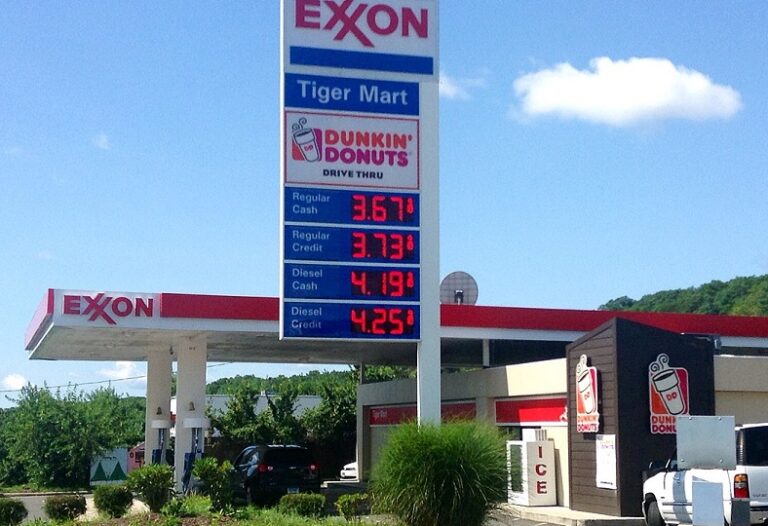
For investors, this causal chain is of concern than about whether ExxonMobil or Chevron are benefiting from higher oil prices. In fact, diesel prices are set to deliver a punch to the economy as truckers/shippers and even manufacturers face higher costs as winter sets in. Some may go out of business, unable to pass on their higher operating costs. That’s just an example of the pain of too high energy prices.
As typical of stagflation periods, high costs, supply shocks when added to inflation and rising FED rates spells trouble. The combination of signals is hard to ignore for retail investors who far from Tom Lee’s forecast of a face ripping rally, might look to cut their risks.
The Federal Reserve Has Changed the Market Equation
The Federal Reserve reinforced this with their priorities on September 16 as they raised the federal funds target range by 0.25 percentage point to 3.75%–4.00%.
The US Economy is Doing Well Despite High Energy Prices
The Fed’s statement was clear and direct: Economic activity is expanding at a solid pace, domestic spending remained resilient, and capital investment is robust while inflation remains elevated. The central bank said the increase was intended to support a more timely return of inflation toward its 2% target.
This matters because investors spent much of the previous cycle anticipating eventual monetary easing. Now, as high oil prices surge into the economy, with no apparent date for easing, they may be revising their previous assumptions.
The Federal Reserve’s September projections also showed policymakers expecting a federal-funds rate around 4.1% at the end of 2026, suggesting that restrictive monetary conditions may persist longer than many investors had previously anticipated.
Mortgage rates, corporate borrowing costs, commercial financing, leveraged acquisitions and equity valuations ultimately depend heavily on the broader bond market. Rising rates could slow the housing market, and slow construction.
And the bond market is sending an increasingly serious signal.
The 5% Treasury May Matter More Than $90 Oil
Oil prices can change quickly, but buyers may jump on supply faster because they don’t believe the price will remain lower.
A diplomatic agreement involving Iran, improved shipping through the Strait of Hormuz or increased global production could potentially remove some of the geopolitical premium from crude. But not much has happened in that relationship so far.
Long-term Treasury yields present a more structural problem. On September 25, the 10-year Treasury yield reached 5.2297%, while the 30-year Treasury reached approximately 5.53%. Significantly, yields continued rising even as oil prices declined. That suggests investors are concerned about more than a temporary energy shock.
Persistent inflation, strong economic activity, government borrowing requirements and expectations of further Federal Reserve tightening are all influencing the long end of the bond market.
For stock investors, a 5% Treasury yield changes basic valuation mathematics.
A few years ago, when risk-free government bonds offered relatively little income, investors had strong incentives to accept higher valuations for companies promising substantial growth many years into the future.
At a Treasury yield above 5%, investors have investment options given bonds and treasuries now look almost as good as stocks.
They can receive a substantial nominal return from U.S. government securities without assuming ordinary equity risk. Stocks will have to re-earn a reason to buy them. So money may flow out of securities into the bond market, and all those trillions sitting in the bond/money markets may prefer to stay put.
Higher interest rates increase the discount rate applied to future corporate earnings. The farther those earnings lie in the future, the greater the mathematical effect.
That is one reason highly valued growth stocks can become particularly sensitive to changes in long-term bond yields.
The market does not necessarily need lower interest rates to advance. However, companies increasingly need earnings growth strong enough to justify competing with a risk-free yield above 5%.
AI Is Providing Much of the Market’s Growth Argument
This is where artificial intelligence becomes central to the broader market outlook.
AI is no longer simply a technology-sector story.
It has become a major capital-investment cycle involving semiconductors, networking equipment, cloud computing, electrical infrastructure, utilities, construction, data centers, cooling systems and corporate software.
The scale of investment is large enough to affect the broader economy.
That spending is also one reason equity markets have remained resilient despite rising interest rates and geopolitical uncertainty.
On September 25, technology shares continued supporting the S&P 500 even as Treasury yields remained at multi-decade highs. Microsoft rose following new AI-product announcements, while several semiconductor and technology companies also advanced.
This produces an unusual situation.
One of the forces helping the stock market withstand high interest rates is also contributing to the economic strength that allows interest rates to remain high.
AI investment supports employment, construction, equipment purchases, electricity demand and business investment.
Strong investment supports economic growth which increases inflationary pressure which encourages the Fed to maintain tighter monetary policy.
The resulting relationship looks something like this:
AI investment → stronger capital spending and economic activity → greater inflation pressure → higher interest rates → higher financing costs → greater pressure on AI investments to produce real returns.
This feedback loop could become one of the defining characteristics of the next stage of the market cycle.
The AI Trade Is Beginning to Diverge
Investors increasingly appear unwilling to treat every AI-related investment equally. Equity investors remain enthusiastic about companies that can demonstrate strong demand, expanding revenues or clear competitive advantages.
Bond investors, however, are becoming much more selective about the enormous financing requirements associated with AI infrastructure.
Goldman Sachs estimates cited by Reuters indicate that gross debt issuance from hyperscalers could reach approximately $420 billion in 2027—about 60% above estimated 2026 issuance.
That’s a lot of capital yet investors are already demanding additional compensation for delivering.
AI-related investment-grade bonds have recently traded at spreads of roughly 115 basis points, compared with approximately 78 basis points for the broader investment-grade market. Importantly, bond managers interviewed by Reuters did not generally express concerns that the largest technology companies were at immediate risk of default. Their concern was different: the amount of borrowing is enormous, additional issuance is expected, and visibility into the ultimate return on that investment remains incomplete.
That distinction matters.
The bond market isn’t necessarily showing that AI investment is failing but instead, that at this scale, AI investment needs to prove that the returns will justify the capital being committed.
Equity investors may eventually ask the same question more aggressively.
There appears to be a significant political effort to cause a failure of AI through regulations, via fears about AI mistakes and economic or military threats of AI systems. It’s added to downward pressure on AI stocks, yet those hanging onto AI stocks are preferring only the best ai stocks — the hyperscalers themselves, which makes sense because these mega sized companies have more diverse revenue sources, and veritable monopolies. Risk is lower, with big upside when the US economy gets rolling again. But it’s a long waiting game now.
The Key AI Question Returning is About Return on Capital
For several years, investors largely rewarded companies for demonstrating their participation in artificial intelligence. But now they’re paying closer attention to what they’ll receive in return for massive AI spending. A corporation spending $20 billion, $50 billion or $100 billion on data centers can no longer be evaluated solely by whether management considers AI strategically important.
Investors increasingly need evidence that investment produces:
- increased revenue,
- higher productivity,
- sustainable margins,
- additional cash flow,
- stronger customer retention,
- lower operating costs, or
- some other measurable economic return.
The distinction between AI investment and AI profitability could become extremely important to whether investors commit to AI stocks.
The technology may continue transforming the global economy while individual investments, companies or infrastructure projects still produce disappointing financial returns. Both things can be true simultaneously which makes the AI market considerably more complicated than a conventional bubble-or-no-bubble discussion.
Why Stocks Have Not Broken Under the Pressure
Given oil prices, interest rates and geopolitical uncertainty, some investors may reasonably wonder why the market remains so strong. They might be miffed at why we haven’t yet seen a stock market crash. One answer is that the U.S. economy itself remains relatively strong.
The Federal Reserve continues to describe economic activity as expanding at a solid pace. Business investment remains robust, while AI-related spending is injecting unusually large amounts of capital into the economy. Corporate earnings therefore remain the critical counterweight to high interest rates.
If earnings continue growing strongly, stock prices can potentially withstand higher bond yields. But the relationship is becoming less forgiving. At lower rates, investors could tolerate missed earnings, distant profitability and ambitious growth promises. Now with 5% Treasury yields, the margin for disappointment narrows.
It might eventually produce a healthier but more discriminating stock market. Companies producing genuine earnings growth may continue doing well but bompanies relying primarily on valuation expansion may be vulnerable.
Five Numbers Investors Should Watch
Retail investors do not necessarily need to forecast geopolitical events or Federal Reserve decisions.
It may be more useful to monitor the variables transmitting those developments into stock prices.
- WTI and Brent crude oil: Sustained declines would reduce one important source of inflation pressure. Persistent prices near or above present levels would keep pressure on transportation, consumers and corporate margins.
- The 10-year Treasury yield: This may be one of the most important numbers in the market. A sustained move above 5% increases competition between bonds and equities and raises the discount rate applied to future earnings.
- Federal Reserve policy expectations: One rate increase matters less than whether investors begin expecting an extended tightening cycle.
- AI capital expenditures: Continued spending supports semiconductor, infrastructure and technology demand, but rapidly rising expenditures also increase the amount of revenue eventually required to justify the investments.
- AI profitability and cash flow: This may eventually matter more than AI spending itself. The companies demonstrating genuine economic returns from artificial intelligence may begin separating from those merely participating in the investment cycle.
A More Demanding Market May Be Emerging
We may be entering a market in which the relationship between price and underlying economic return becomes more important again. And the time required for an investment to produce an economic return matters more.
Artificial intelligence may ultimately produce enormous productivity gains and some of the most important companies of the next several decades. But the scale of today’s AI investment means that optimism alone will eventually be insufficient. The AI infrastructure has to generate economic value or we could see a bigger drop in AI stock prices, and a lowering estimate of a US economy firmly committed to AI technology.
The key question underneath today’s confusing market isn’t whether oil prices will fall, whether the Federal Reserve will raise rates again, or whether AI stocks will rally.
It’s whether corporate America can generate enough earnings growth to overcome a structurally more expensive cost of capital.
For now, the stock market appears to believe that it can.