
Use the AI Search Threat to Your Advantage
If you’ve found your free organic Google traffic, repeat visits, and online sales dropping at an alarming rate, you’re not alone. Both SMBs and large corporations, news media and even government sites are seeing their free organic search traffic disappear.
When a company loses its Google search visibility, the losses mount in many areas of marketing, sales and operations. Worse, AI can segment searches intricately, resulting in deeper erosion of your visibility than you expect. It’s losses in ways even the experts can’t fathom.
And the rate of loss of Google organic search clickthrough traffic of late is alarming. US, Canadian and European travel agencies, DMOs, real estate agencies, and SaaS software companies are suffering the same plight – their free website visibility and traffic are falling.
For instance, this report shows the biggest losses during 2025. Real estate websites, according to the Digital Bloom report saw AI overviews having a 258% increase, which means substantial losses in clicks to real estate websites.
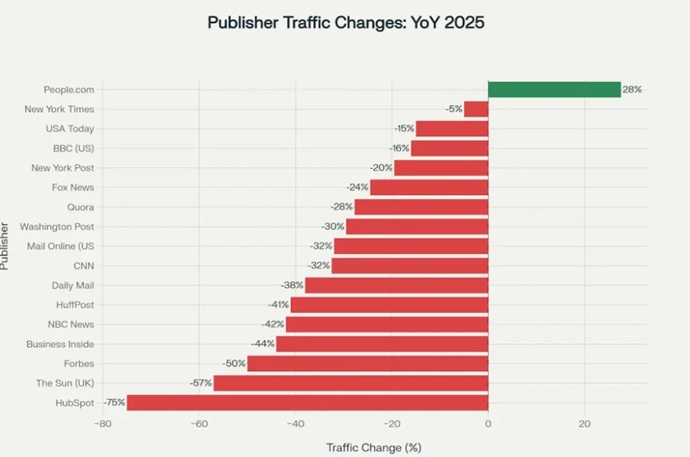
Some good news: is that most of lost traffic is due to informational inquiries, not direct branded or transactional search queries. We still have opportunity in Google search, meaning advanced SEO is important.
I don’t want to get all alarmist, but experts are talking about the dismantling of the web — where Google, OpenAI and META close all gateways to web content. That squeeze has been happening for a while. They want to monetize every second of consumers time online — for massive profits. Their challenge is that if content is no longer created and published on websites, what will Gemini and ChatGPT scrape for their own answers?
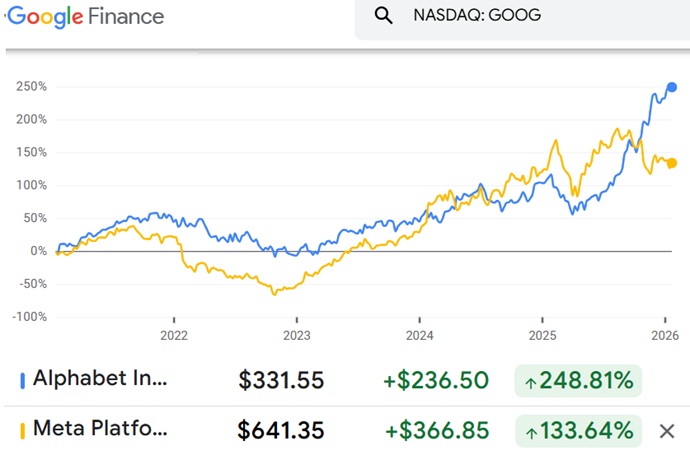
Google’s stock price is rocketing due to this AI search opportunity, while META’s not enjoying it.
SMBs Forging a New Approach to Digital Marketing
For you as a business owner, the AI incursion will force you to change your approach to digital marketing. Like many business owners, you might think AI marketing tools and AI agents are coming to the rescue. A recent post however, shows that businesses aren’t seeing increases in revenue or cost cuts when they’ve adopted AI. It could be, that AI is simply a threat rather than an asset.
In this post, I’ll help you see what’s happening and why your content might not be valued anymore. Please bookmark this post, as soon, I’ll present a powerful AI-Resistant Content Marketing Strategy — a Complete Action Plan to keep you visible and successful online.
In fact, Digital Bloom published some stats regarding the continuous value of good rankings. Here’s a summary:
- The average #1 ranking on Google receives 27.6 of all clicks
- the top 3 results collectively capture 54.4% of all clicks
- featured snippets at top of results receive a 41.9% CTR
- organic search still accounts for 53.3% of all website traffic
- conversion rates on organic traffic ranges from 2.7% to 3.75%
- SEO leads close at 14.6% vs 1.7% for outbound leads
- organic search drives 44.6% of all revenue derived – 2X all other channels combined

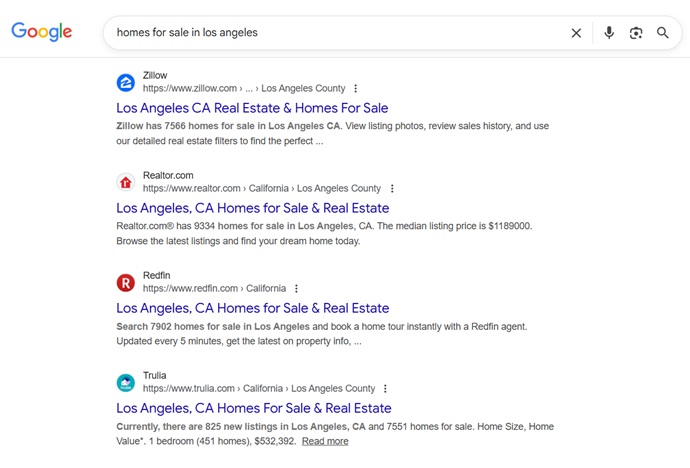
These two Google search queries above show that free organic listings for products/services display real, actual businesses to buy from. Google however, as you may know, has been regularly demoting organic search results in favor of ads, AI overviews and extraneous search boxes, to push what users want deep down the page resulting in less traffic for small businesses. Travel searches tend to be very informational, thus travel companies stand to see big traffic losses.
According to a Brightedge report, one year ago, Google AI Overviews were showing for 30% of travel-related queries. That’s likely increased. That trend reflects the threat to traditional Google search referrals.
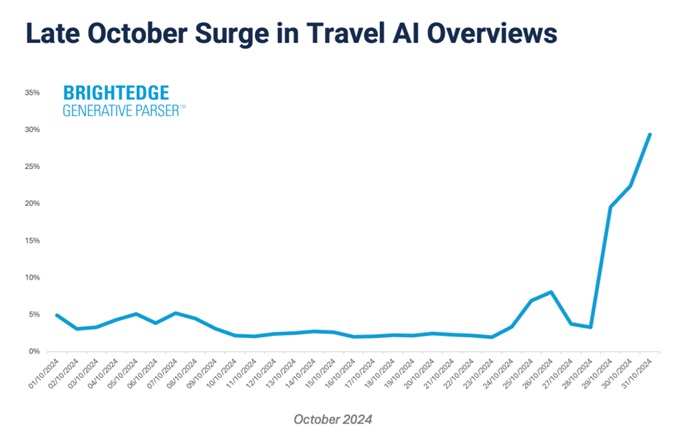
Big Push By Google and OpenAI to Overviews – the Zero Click Environment
It’s a trend to making websites invisible in search while providing a wider path to their AI-driven information or shopping experience – an alternate world of information experience.
Google is emphasizing its use of its AI overview mode and promoting its Gemini AI search engine to serve its own revenue and business goals. As a result, search engine optimizers are hyping up GEO, AEO as sure fire solutions. Whether they do prove productive is still ahead of us. Early reports are not promising. So most haven’t found their ultimate solution.
You can improve your content and build the highest success and user engagement, proving strong relevance to users, and yet still not show in AI engine answers/rankings. So AEO or GEO likely will not be the sales generating savior SMBs are hoping for. The human enjoyment of content isn’t a factor in AI search engines. Whether your content is cited in AI answers (AEO) depends entirely on how it answers a question and is relevant to a specific topic.
And your backlinks from other industry-related websites may suggest your site is authoritative, trusted and valuable, yet AI engines do not follow links. They don’t see those links as a recommendation by real people and authoritative people. Links were the core factor in Google’s search results quality check.
Naïve User’s Goodwill is Being Preyed Upon
Users now enter a world of AI-generated answers where most assume the scraped and processed information an AI Chatbot provides is accurate, not stolen, not political-ideology tainted, and free from coercion. This is the content you’re competing with.
I’ve used AI chatbots (i.e., ChatGPT) with extended sessions of questions and answers, where I challenged their output. Interestingly, AI search engines are evasive, altering the context, constantly providing excuses, and justified biases. I found even after continuous questioning and doubting its reasoning, I could not get the bias out of its responses. Many times, there was a Woke bias in it that it would not let go of — it is part of the foundation of the AI system. So clearly, at least to me, the AI engines can present a version of reality, products, ideology, and services that could be highly biased against small businesses – citing small company’s lack of authority, trust factors, and content coverage as reasons for not referring any traffic to their websites. Large corporations on the other hand could meet the tough criteria and still be included in AI answers and citations.
Given Google and ChatGPT will scrape your new content continuously, they can leverage it for the improvement of their user retention rather than sending them to your site. It’s a matter that is being fought in world and US courts right now, where legislators want to ensure sites can be ranked while Google cannot steal their proprietary content. If you block the AI engines from stealing your content, you won’t be visible in their search indexes. It’s a little like extorsion. In essence, you can’t stop Google or OpenAI from stealing your content right now. But that might change given law suits being launched by publishers. If it does, and Google/ChatGPT are prevented from this content theft, it would return traffic to small companies who can produce high quality content experiences.
Currently, many companies are turning to SEO/GEO experts to provide sophisticated strategies and techniques that will help them qualify for presence on Google search (advanced SEO) and in the world of zero-click AI generated answers (GEO). Whether any of this works continuously remains to be seen. Thankfully, there still are billions of searches that we can all tap into.
You Can Always Advertise, Right?
Well, small companies can advertise on Google (and soon ChatGPT), or place ads on other industry websites or media sites. With all websites seeing less traffic, ad placements on them might generate few leads or revenue.
Given the cost to advertise on Google’s monopoly search sites and on Facebook’s sites (Google and META account for most of the internet advertising market), small businesses may not be able to afford ad-based sales and lead generation. With so few ad spots available, competition is driving up pay per click prices. Advertising might not be a viable option for you in the years ahead. If you intend to rely on ads, then a persuasive content strategy is a wise choice. I can help you build your persuasive content architecture.
Even with the most persuasive and high-converting content experiences, competition and inflation are making the online space difficult to thrive in.
How Will Small Companies Adapt?
In response, digital marketing success now requires:
- genuine expertise
- persuasive content depth/experiences that AI cannot replicate
- multi-platform presence
- optimization for AI citations alongside traditional rankings
- business models that generate value from visibility even when traffic declines
You can fight back and adapt with a new plan a AI-Resistant Content Marketing Strategy –a Complete Action Plan. It’s one that helps you create better content experiences, customer loyalty, and visibility in online search.
This will be the next insight for you to enjoy, hopefully helping you get an edge in this constant struggle for business survival going on.
Your strategy will incorporate AI search engine optimization strategy, given AI Chatbots are improving their output, and users enjoy the tremendous speed and range of knowledge they provide. Regardless of your traffic sources, persuasive content experience optimization is essential. Persuasion is where marketing is weakest — presenting you with your biggest opportunity.