
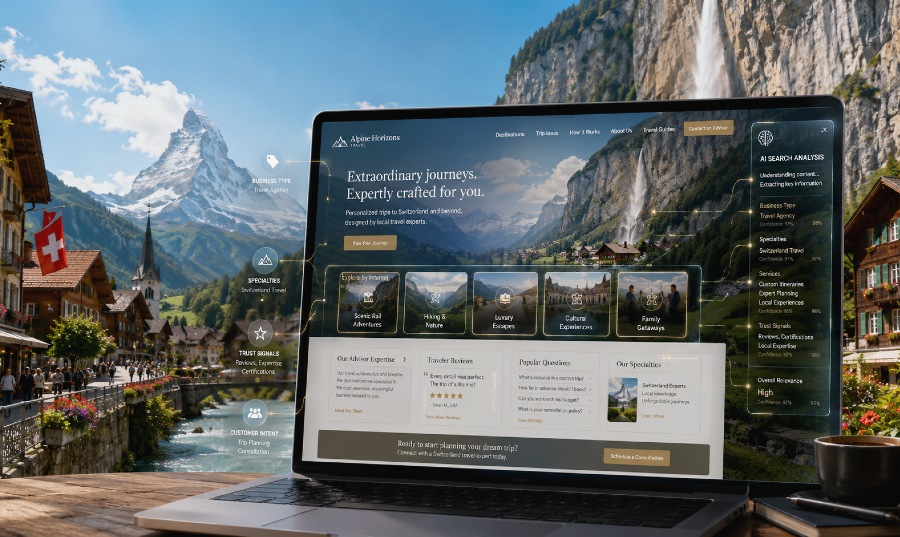
Your Homepage Priority: How AI Search Understands Your Travel Agency
Studies suggest AI systems overwhelmingly make visits to your website’s homepage, as if it’s some sort of trustworthy oracle about your business.
This habit occurs even if your real “goldmine” content pieces are your blogs or product pages.
But most businesses, including travel agencies, publish homepages with little information, designed more as a snazzy, eye-opening campaign brochure or magazine layout. And agency owners have little feedback as to whether it’s hurting or helping to create bookings. There’s something about the homepage (the target of most of your backlinks) such that AI LLM’s lean on it to evaluate your company’s reputation and purpose. AI seems to need that information anchor.
Why might AI search bots prefer your homepage?
- The homepage normally provides the broadest set of navigation links and therefore acts as the site’s principal discovery hub.
- The homepage might be considered the most trusted page with the least irrelevant/low quality content.
- AI systems need to understand the business entity, not merely collect pages.
- Many AI visits are probably not full-site crawls and could instead be systematic training crawlers or real-time grounding bots.
- AI systems don’t refer to links but rather to entities (e.g., your company name) and then automatically search for your homepage.
- AI systems may be using a minimum-fetch strategy to save time and resources.
- The homepage receives most external authority signals from web citations, links, PR
For the past 30 years, homepages have been a strongly visited and preferred destination. Only in the last decade, where Google pushed users deeper into content, that the homepage was demoted. That caused many publishers to neglect the home page, dominating it with video, heavy visuals, code bloat and other elements that gave their site a poor core metrics rating from Google. This affects Google search rankings and reduces AI search exposure, since AI bots prefer fast spidering. They don’t like inefficient web content that makes them work hard to extract content and the meaning of that content.
The job lands on the AEO/SEO pro’s desk. Increasingly, the full task must be handled by the AI content strategist because increasingly, the key is the accuracy/quality/depth/authority of content that will determine AEO visibility — a key to future organic visbility.
Consumers are increasingly using AI search engines and chatbots to find info, providers, and products. Which means it’s important for them understand your business as you communicate it on your homepage, about page, FAQs, product pages and more. Right now, your business’s visibility in ChatGPT, Gemini, Claude, Perplexity or Copilot, might need to improve because AI Chatbot referrals can be high-converting. Review the AI technology posts for deeper and broader insights into AI marketing trends.
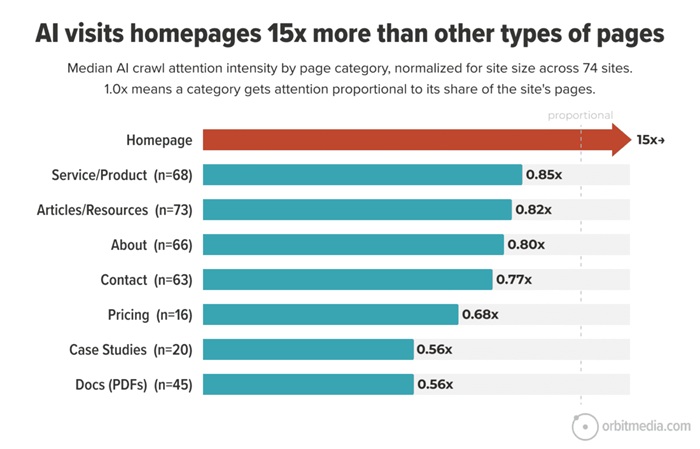
If the AI LLM algorithm trend continues, your AI search visibility, leads and sales may deteriorate. Consumers will then find your competitor’s content and homepages instead.
AI LLMs and Chatbots View Your Website Differently than Humans Do
AI search systems do not evaluate a travel agency homepage the same way a human visitor does. A traveler may respond first to beautiful images, creative slogans, emotional language, destination dreams, and a friendly brand tone.
AI systems however, need something more explicit. They need clear business meaning.
That means your homepage should help AI search engines understand:
- What kind of travel agency you are
- What types of trips you plan
- Which travelers you serve
- Which destinations or travel styles you specialize in
- Why your advisors are credible
- What concerns your clients usually have
- What evidence proves your experience
- What makes your agency different from a booking site or generic online travel platform
- What next step a traveler should take
This is where many travel agency homepages fall short. They lack signals, indicators, and relevant content for ChatGPT, Gemini, Perplexity or Claude, and may not even help the best traveler prospects understand the agency’s true value for them.
Your Agency Homepage: The Entry Portal for Your Business
A GEO-ready homepage should do 5 important things.
1. Name the travel categories clearly
AI systems need to know what travel services your agency should be associated with.
A homepage with trite phrases such as “dream cruises” or “unforgettable adventures” doesn’t provide the specific meanings you need to establish.
As an example, a stronger homepage might include the real travel category and the travelers’ need for that vacation, such as:
Custom Europe vacations, luxury cruises, family vacations, honeymoons, river cruises, wellness retreats, destination weddings, group travel, adventure travel, or all-inclusive resort planning for US vacationers who need an agency with strong advisory services, for the exact perfect trip itinerary.
As opposed to overusing keywords, the copywriting clarifies the agency’s actual areas of service categories and the traveler’s purpose, and is categorized and connected to relevant traveler searches and lengthy chatbot conversations. As discussed in the GEO article, AI is fairly literal and strict about meanings. Creative phrasing may confuse them.
2. Signal advisor expertise
AI search systems need evidence that the agency has real expertise, not just attractive marketing language.
This essential expertise (in SEO it is referred to as E.E.A.T) is shown through advisor bios, years of experience, industry expert reviews/recommendations, destination knowledge, supplier relationships, certifications, professional affiliations, first-hand travel experience, client stories, and examples of trips planned.
How you express your competence determines whether it is believable.
As an example, instead of saying:
“We create amazing vacations.”
You could say:
“Our advisors specialize in custom Europe itineraries, luxury cruises, and family vacations, helping travelers compare destinations, hotels, tours, travel timing, and itinerary options with confidence.”
That sentence gives AI systems and human visitors more and clearer proof of what the agency actually knows how to do and has done. When it is supported by links to real travel adventures, AI engines receive the assurance of trustworthiness they must have.
3. Reflect traveler concerns
AI search is often driven by questions. Travelers are not only searching for destinations. They are also looking for reassurance.
They may be wondering:
Should I use a travel advisor?
- Does this agency provide quality tours I can depend on?
- Will this trip fit my budget?
- Can someone help if something goes wrong?
- How do I know which resort, cruise, or itinerary is right for me?
- Can I trust this agency with an expensive vacation?
- Will I get better guidance than I would from booking online?
A strong homepage should address these concerns directly. This helps AI systems understand the agency’s relevance to real traveler problems, and it helps human visitors feel understood.
4. Support SEO and GEO understanding
SEO and GEO both depend on clarity.
Search engines and AI systems need visible page content, headings, internal links, service descriptions, FAQs, structured data, and consistent terminology to understand a business. This means the homepage should not rely only on title tags, meta descriptions, plugins, or schema markup. Those elements can help, but they cannot replace clear, organized, visible content.
The homepage itself should explain:
- who the agency serves, what it offers, what it specializes in, what makes it credible, and where visitors should go next.
This is why homepage copywriting is becoming a more strategic skill. The goal is not to make the page sound robotic. The goal is to weave business meaning into persuasive travel copy that makes visitors feel good.
5. Build trust with evidence
AI systems and human travelers both need trust signals.
A homepage should include visible evidence such as testimonials, review ratings, years in business, advisor credentials, destination specialties, supplier partnerships, awards, media mentions, case examples, and client success stories.
Trust cannot be implied only through beautiful design. It has to be demonstrated, and this is done through words which the AI system validates as part of its indexing practices.
For travel agencies, this is especially important because travelers are making emotional, financial, and logistical decisions. They need to know the agency can guide them well, protect their time, reduce uncertainty, and help them make a better travel decision.
For your travel agency’s homepage, that means the content should:
| AI/Search Need | Homepage Content Should Show |
| Business identity | Agency name, location, market served, travel focus |
| Service relevance | Trip types, destinations, planning services |
| Expertise | Advisor experience, specialties, credentials |
| Traveler concerns | Questions, objections, risks, decision worries |
| Trust | Reviews, proof, examples, testimonials, affiliations |
| Authority | Destination knowledge, planning process, client guidance |
| SEO/GEO clarity | Headings, service sections, internal links, FAQs, schema |
| Conversion path | Consultation, trip request, inquiry form, next step |
Summing Up the Homepage Optimization Priority
Your agency homepage shouldn’t be a slow-loading, time-wasting presentation to everyone, especially one that doesn’t really differentiate your brand, nor deliver a truly impactful effect on travelers.
In optimizing your homepage, you’re actually providing even better value for visitors, and proving relevance to make all search engines trust you more. Because search engine algorithms are very sophisticated now, and are able to view many indicators of the truth/focus of your business. Your improvement extends beyond GEO for travel companies to SEO, content strategy, impact and engagement, persuasion and lead conversion improvement.
Creativity without credibility and proof more often fails to impact and engage, which makes conversion behaviors much less likely. Trust and authority are more important today. And of course, travelers themselves are uncertain, demanding and impatient. AI engines are particular about accuracy and credibility.
The more clearly your homepage communicates that value, the easier it becomes for AI search and Chatbot systems to understand why your agency deserves attention, and why travelers should see your agency as the only one for them.
As part of my AI marketing intelligence optimization service, a data-informed, strategic design of homepage content can be done. If you have little traffic to your homepage now, it makes sense to run some tests to see what it produces.
If you’re not enthused with your marketing intelligence/insights dashboard, then it might be time to have me study situation and provide some recommendations on potential improvements.
You can reach me, Gord at 416 998 6246. The best time to start is now!