
Bitcoin Price Forecast 2026–2027: Is Now a Good Time to Buy?
Updated November 3, 2026 | Bitcoin (BTC/USD) cryptocurrency outlook
Bitcoin has fallen far enough to tempt bargain hunters. But is it actually cheap—or just an expensive asset in another temporary recovery?
Is Crypto the right choice vs Ai stocks or oil stocks, or many of the stocks with great outlooks on the S&P 500, Russell 2000 or Dow Jones? The factors that make cryptocurrency and BTC investable are very complex. Pealing away those layers of complexity, giving you clear view is a great way to reducing your risk in buying Bitcoin.
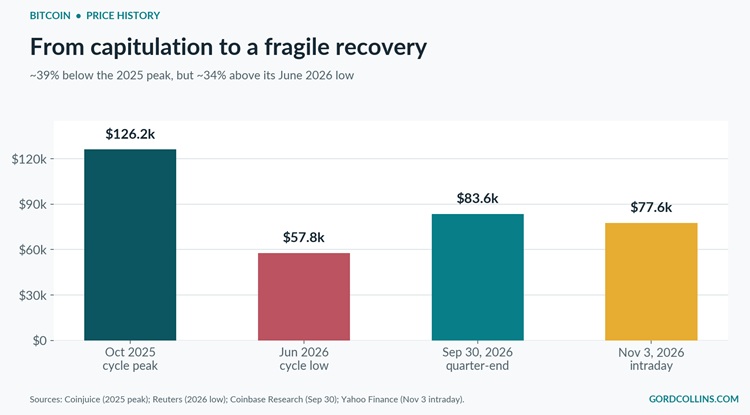
Today, on U.S. midterm election day, Bitcoin was trading around $77,600, approximately 39% below its October 2025 peak near $126,000. Investors who watched it rebound from a June 2026 low near $58,000 have good reason to be interested. Yet Bitcoin has been weakening again, and more than $1 billion left U.S. spot Bitcoin ETFs over the last two completed trading sessions. CoinDesk
For cryptocurrency investors the challenge/opportunity is volatility and whether longer-term forces driving adoption, demand and scarcity are strong enough to persevere through another deep decline before seeing a profit. BTC price has risen in late 2026, but will the mid-terms and end of the Iran War have sufficient impact on continue price growth going forward. The fear of another collapse is always there. Investors need to know what drives these price surges and drops.
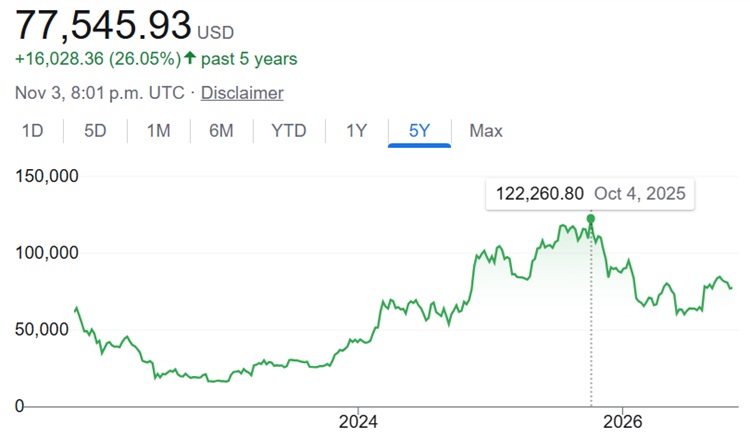
The November 2026 outlook: The long-term investment case remains interesting; the short-term buying signal is not yet convincing. A staged purchase can be more defensible than betting everything on election-night headlines, particularly for investors who can tolerate substantial losses and have a multi-year horizon.
Why Bitcoin Is Back on Investors’ Radar
Bitcoin has already endured a brutal cycle. After peaking above $126,000 in October 2025, it fell to roughly $58,000 in June 2026. It then recovered 43% in the third quarter to approximately $83,600 at September’s close, according to Coinbase Institutional. October’s reversal and renewed November selling reveal that confidence has not fully returned. Coinbase Research
A large decline does not, by itself, make Bitcoin undervalued. Unlike an operating company, Bitcoin has no earnings, dividends or discounted cash flow to anchor its price. Its valuation depends on whether investors continue to demand a scarce, transferable asset with a credible, durable network. This makes market liquidity, risk appetite, custody security and trust central to the outlook.
Three developments matter particularly now.
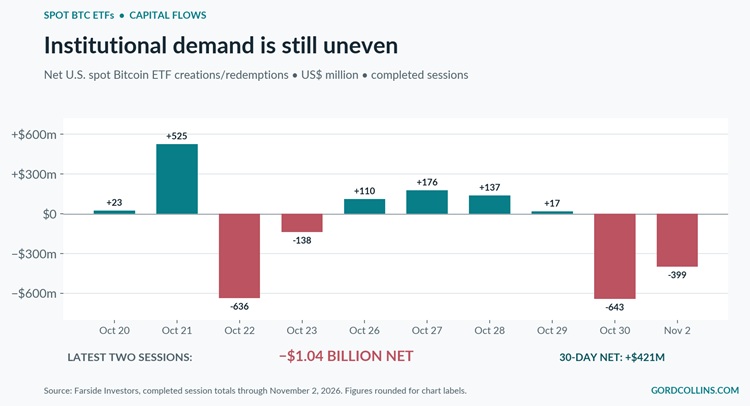
First, Bitcoin has institutional distribution that earlier cycles lacked. U.S. spot Bitcoin ETFs have accumulated approximately $56.6 billion in net inflows since January 2024. But that long-term adoption story is being tested: the funds recorded outflows of about $643 million on October 30 and $399 million on November 2, a two-session reversal of approximately $1.04 billion. Fund flows are neither a pure buy signal nor a measure of all Bitcoin demand; they show whether an important group of buyers is adding or withdrawing capital. Farside Investors
Second, the investment environment has become less accommodating. Sticky inflation, elevated Treasury yields, global conflicts and questions about expensive AI investments can all discourage risk-taking. Higher real interest rates make non-yielding assets such as Bitcoin less attractive. This may matter more than the precise composition of the next U.S. Congress. Bitwise Europe, November 2
Third, crypto-specific risks have not disappeared. The recent Binance security breach and exchange withdrawals have reminded investors that the value of a decentralized protocol and the safety of the businesses handling customers’ coins are separate questions. Anyone buying directly must take custody arrangements, exchange solvency, scams and private-key security seriously. Reuters | 21Shares
Will the U.S. Midterm Elections Change Bitcoin’s Direction?
The November 3 elections matter to cryptocurrency investors mainly because Congress can influence how digital-asset market structure, exchanges, stablecoins and financial supervision evolve. Different legislative outcomes could change the speed or content of future regulation. But election results do not directly create demand for Bitcoin, and any initial market move may be short-lived.
There is an intriguing historical comparison. On the midterm election days in 2014, 2018 and 2022, Bitcoin was trading below its 200-day moving average—by roughly 35%, 9% and 22%, respectively. On November 3, 2026, it was instead about 5% above that average, near $73,200, in morning trading. That suggests a healthier long-term trend than on those earlier election days; it does not prove that a rally must follow. Three past elections are too small a sample to forecast the next year reliably. CoinDesk, November 3
What may matter more this week is the direction of ETF net flows (institutional investor involvement) Treasury yields, Friday’s U.S. employment report, and any further surprises in global credit or energy markets. Political news is one catalyst in a larger investment equation.
The 5 Biggest Factors Determining Bitcoin’s Price
| Factor | What drives Bitcoin higher or lower |
|---|---|
| 1. Global liquidity and interest rates | Falling interest rates, easier credit and more available investment capital generally support Bitcoin. Tight monetary conditions can suppress demand. |
| 2. Institutional investment flows | Buying and selling through Bitcoin ETFs, investment funds, corporations and large holders can move prices substantially. Sustained net inflows are bullish. |
| 3. Investor confidence and risk appetite | Fear, economic uncertainty and stock market selloffs encourage investors to reduce speculative exposure. Optimism and confidence encourage buying. |
| 4. Available supply versus new demand | Bitcoin’s issuance is limited, but existing holders can sell. Prices rise when new buying demand exceeds the coins offered for sale. |
| 5. Regulation and cryptocurrency market stability | Supportive regulation can encourage adoption. Exchange failures, security breaches, restrictive rules and loss of trust can trigger selling. |
What Three Bitcoin Experts Say
1. Alex Thorn — Galaxy Research: A Possible Accumulation Phase
In an October 26 report, Galaxy’s head of firmwide research argued that long-term selling pressure had faded, investors were less euphoric, and Bitcoin’s earlier bear market might have ended in June. His conclusion was clear:
“we believe now is an attractive time to buy and hold bitcoin.”
Thorn’s research also provides a useful way to test his conviction. He said a weekly close below the 50-week average near $76,540, followed by failure to reclaim it within a month, would challenge the bullish thesis. The argument is not simply buy because prices fell; it is buy if accumulation is real and longer-term technical support survives. Galaxy Research
2. Matt Hougan — Bitwise: The Big Long-Term Opportunity
Bitwise chief investment officer Matt Hougan updated his long-term Bitcoin valuation model on October 28. Despite the difficult 2026 bear market, the firm raised its central long-horizon model estimate. As Hougan put it:
“we’re raising our 10-year forecast from $1.3 million to $1.6 million.”
The model’s 2036 figure depends on significant expansion in Bitcoin’s share of store-of-value and institutional investment markets. It is not a credible 2026 or 2027 trading target, nor a guaranteed outcome. What it demonstrates is how institutional bulls connect future adoption and portfolio allocations to potentially much higher valuations. Its assumptions should be challenged just as closely as those in a bullish equity research report. Bitwise, October 28
3. André Dragosch — Bitwise Europe: Macro Conditions Still Matter
André Dragosch, head of research for Europe at Bitwise, and senior research associate Luke Deans reached a more cautious near-term conclusion in their November 2 research:
“Bitcoin remains in wait-and-see mode”
Their analysis highlights tight financial conditions, inflation and the risk that AI-related market weakness could spill into cryptocurrencies. They regard the midterms as less important to current prices than those macroeconomic forces. This is an important counterweight to forecasts based solely on adoption or a bullish four-year cycle. Bitwise Europe, November 2
All three firms offer crypto-related investment products or services, so readers should treat their forecasts as informed but interested opinions, not independent guarantees.
Political Influences and Reactions To Watch
The 5 Key Political Factors Bitcoin Investors Should Watch
Politicians have considerable opinions and can impact BTC price. Policies regarding prioritizing the US dollar, regulations, and government purchases can significantly affect BTC prices. Some might say they have the biggest effect.
| Political factor | How it influences Bitcoin prices | What investors should watch |
|---|---|---|
| 1. Presidential actions and announcements | President Trump’s statements can shift expectations quickly. His cryptocurrency policies and Strategic Bitcoin Reserve initiative can reinforce confidence, but actual policy implementation matters more than promises. | White House announcements, Treasury actions, reserve holdings and evidence of government Bitcoin purchases. |
| 2. Congressional control and regulatory conflict | Today’s midterms will shape the legislative environment. Political disagreement can delay legislation, create uncertainty or change regulatory oversight. Greater legal clarity could encourage investment. | The CLARITY Act, SEC/CFTC regulations, congressional committee leadership and potential investigations. |
| 3. Political pressure on the Federal Reserve | A president may advocate lower rates, but the Fed makes its own decisions. Disagreement over interest rates and central-bank independence can affect bond yields, dollar confidence and Bitcoin’s appeal. | Fed Chair Kevin Warsh’s statements, inflation data, interest-rate decisions and political pressure on Fed officials. |
| 4. Wars, tariffs and international tensions | Military escalation, trade restrictions and diplomatic disputes can generate fear and force investors to sell risky assets. Energy inflation can also keep interest rates elevated. | U.S.–Iran developments, oil prices, tariff announcements and international trade negotiations. |
| 5. Government spending, debt and dollar confidence | Expanding deficits can strengthen Bitcoin’s appeal as an alternative store of value. However, rising Treasury yields, fiscal disputes and financial instability can also cause Bitcoin selling. | Federal budget negotiations, debt-ceiling disputes, Treasury yields, the dollar index and fiscal spending plans. |
Bitcoin Price Forecast for Late 2026 and 2027
Forecasts are unusually dispersed, reflecting disagreements about inflation, interest rates, liquidity and the strength of institutional demand. The following are published external projections, not a consensus or a forecast calculated by this site:
| Analyst or firm | Published Bitcoin price view | Horizon | Important qualification |
|---|---|---|---|
| Bitwise / Ryan Rasmussen | Potentially above $100,000 | End of 2026 | Dependent on stronger demand despite macro volatility |
| LO | $85,000–$95,000 | End of 2026 | More restrained view under inflation and rate pressure |
| Citi | $113,000 | Approximately 12 months from October 2026 | Research price target, not guaranteed |
| Bernstein / Gautam Chhugani’s team | $150,000 base case | Mid-2027 | Conditional on its cycle and valuation assumptions |
Sources: CoinDesk on competing 2026 forecasts, Wall Street Journal on Citi, The Block on Bernstein.
Our scenario framework for the next several months is deliberately conditional rather than a claim of statistical forecasting accuracy:
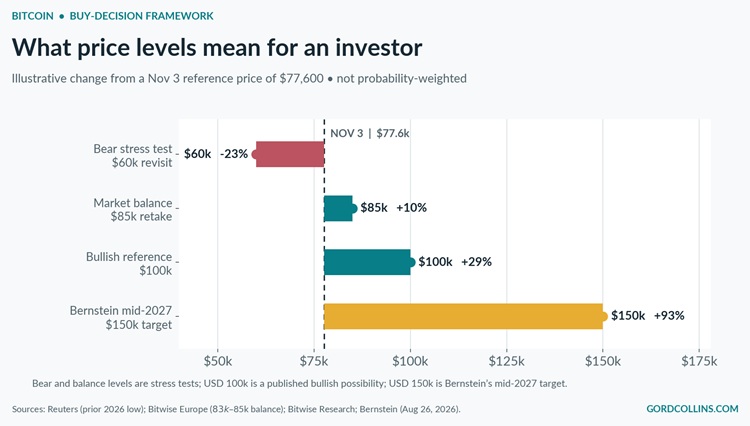
- Bearish: $60,000–$73,000. Continued ETF withdrawals, firmer interest rates, weak technology markets or another loss of confidence could put Bitcoin’s summer support region back in view.
- Base or consolidation: $78,000–$95,000. Bitcoin regains the $83,000–$85,000 economic midpoint identified by Bitwise, but struggles around the $89,600–$93,700 supply zone identified by Coinbase.
- Bullish: $100,000–$125,000. Institutional inflows resume, financing conditions improve and buyers overcome overhead supply. Retesting the old peak would require sustained new demand, not merely a favorable election headline.
These are illustrative price paths, not probability estimates. The ranges are not mutually exclusive over time: Bitcoin could visit a downside level before eventually testing a bullish one.
Is Bitcoin a Good Buy Right Now?
Is this a buy the dip opportunity that some stocks are priced at now, or is it a falling point like it might be for energy stocks, if the Iran War is ended?
For a long-term investor who understands the technology and can withstand a 30%–50% drawdown, the current price may offer a more attractive starting valuation than it did near the 2025 peak. Bitcoin has recovered above its 200-day average, wider institutional access remains intact, and some well-known researchers believe the June low marked a cycle bottom.
But buying a 39% discount to the former high is not the same as buying a safe asset. The latest ETF outflows, fragile short-term momentum and possible tightening of monetary conditions argue against assuming the bottom is secure.
A practical decision framework is to require evidence, not a headline. A cautious buyer can monitor whether Bitcoin holds the $73,000–$76,500 support area, reclaims $83,000–$85,000, and attracts several sessions of fresh ETF inflows. If those developments fail, maintaining cash flexibility may be more valuable than rushing to capture an uncertain rebound.
Investors who choose exposure should consider position size, an ability to hold for years, avoiding leverage, and a staged buying schedule rather than a large all-at-once purchase. Direct Bitcoin, spot ETFs and crypto-related stocks also carry different custody, counterparty and business risks. A Bitcoin miner or exchange stock is not the same asset as Bitcoin.
Cryptocurrency Outlook: Does a Better Bitcoin Forecast Help Other Coins?
Not necessarily. Bitcoin has a relatively clear scarcity and institutional-access thesis. Ethereum derives more of its value proposition from network activity, applications and the demand for its blockchain infrastructure. Solana and other alternative networks may have strong activity but also greater ecosystem and competitive risks. Stablecoins generally aim to maintain a reference value and should not be confused with an investment expected to appreciate like Bitcoin.
The development of regulated products and tokenized finance may benefit the overall industry, but that does not mean every token will capture the value created. For many investors the most important crypto forecast is therefore not which coin will rise fastest? but which assets have durable demand, credible economics and manageable risks? For a deeper foundation, see our 10 Core Fundamentals of Cryptocurrency Trading.
Final Outlook: A Better Entry Point, but Not an All-Clear Signal
Bitcoin on November 3, 2026 offers a compelling contrast: it remains far below last year’s record, yet it is still above its summer low and has a much broader institutional ecosystem than in earlier cycles. That combination may create opportunity for patient, disciplined investors. It can also trap investors who assume the rebound is guaranteed.
The next leg of Bitcoin’s price trend will likely depend more on liquidity, actual fund demand and investor confidence than on election-night excitement. The best buying decisions will come from watching what changes after the headlines—not from trying to predict every headline in advance.
Price and market information is a dated snapshot, not live trading advice. Cryptocurrencies are considered very risky and you can lose most or all of their value. The recent Bitcoin theft of billions highlights the risk even further. Please be cautious in your choice of cryptocurrency choices. The scenarios and commentary here are for general information, not personalized investment advice.
Note: The statements and information presented in this post is not intended as professional investment advice. It is solely an exploration of Cryptocurrency investing and the risks, perils, and behavior of stock markets and the economy. No one should rely on a single source of information or investing professional’s advice. The overall message of the post might be to diversify stock, currencies, real estate, and cash/gold holdings as a hedge against stock market crashes. Investors should look into hedging strategies but be aware that even hedging may provide limited protection from a crash.